

That the powerful play goes on, and you may contribute a verse.
—Walt Whitman
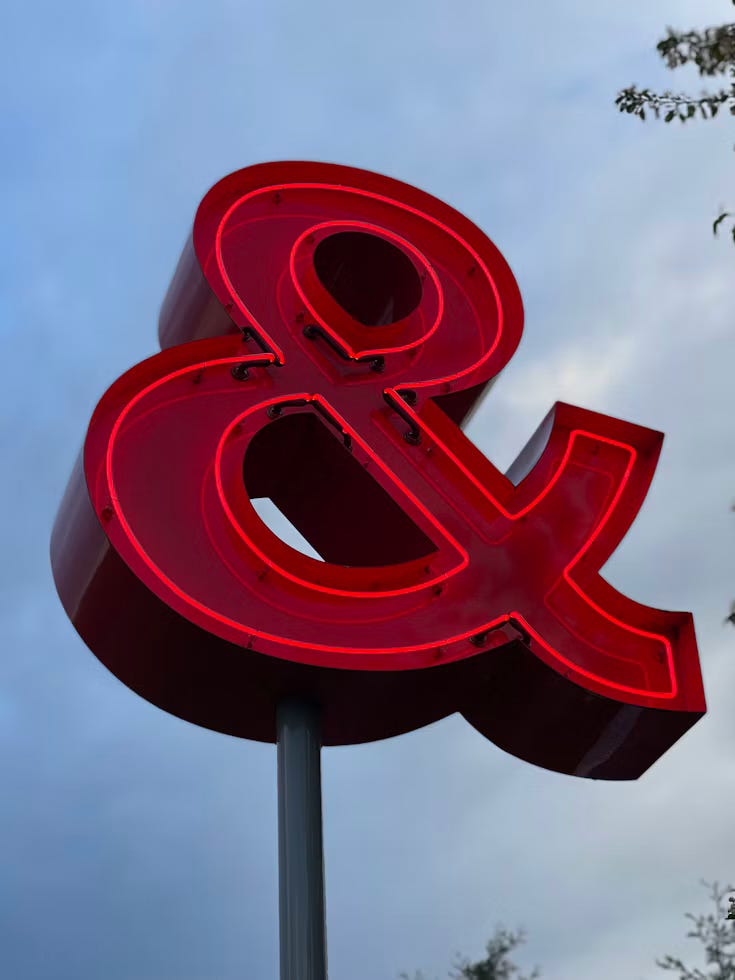
Throughout the nineteenth century, schoolchildren learned that the alphabet didn’t stop at the letter Z. No, dear reader, in the good old days there was a 27th letter: &.
Believe it or not, students would finish their alphabet by saying “and per se and.” This half Latin phrase meant “& by itself is and.” Say it quickly enough and repeat it ad nauseam, you will hear the word ampersand. Taken with that historical context, ampersand is no more than a mispronounced chant that became a word.
Interestingly, the symbol predates the word. Roman scribes wrote the Latin word et so quickly that the e and the t fused into a single shape. In a good italic ampersand, you can still see the two letters melding into one other.
I’ve been thinking about the & lately because of all the buts on the internet these days.1 Not a day goes by when someone posts something and the comments clog up the original thought with debris, doubt, and detritus. Hell, the quote tweet exists so we can disagree and dunk on others in front of an audience.

Improv has a name for this behavior: blocking. If your scene partner tells you that you are both astronauts stranded on the moon and you tell them you’re actually in a dentist’s office, the scene stalls and you have become a blocker.
The antidote is the rule every improv class teaches: Yes, and. You accept what your partner offered. Then you add to it. Perhaps there’s no better metaphor for life.
The “yes” is easy. The “and” is where the hard work happens. If you simply agree with everything your partner says, you aren’t adding anything of substance or merit. “Yes, we are on the moon” is fine but not very exciting. The “and” requires you to listen closely enough so you can actually build upon what you heard.
Perhaps this is why Chatbots and LLMs worry me so. A model that validates every good whim, bad idea, and ugly fancy you bring its way replies with a “yes,” but no “and.” This mechanical partner contributes, and thus teaches, nothing at all.

As a ghostwriter, I do this for a living. My days are no more than continuous improv scenes with founders and funders. I meet ideas, riffs, and half-baked thoughts with “yes and” in order to keep the scene going so that we might extricate some wheat from all the verbal chaff. When it works, lead turns into gold and the reader can’t see where they stop and I start. That’s the ampersand’s kicker: It holds two things together so very tightly that they eventually become one.
The schoolkids who chanted and per se and put the ampersand at the very end of the alphabet. I think it belongs smack dab in the middle of things. Though you can’t spell November without NO, my goal this month is to answer more people with a yes and. I invite you to join me.
Per my about page, White Noise is a work of experimentation. I view it as a sort of thinking aloud, a stress testing of my nascent ideas. Through it, I hope to sharpen my opinions against the whetstone of other people’s feedback, commentary, and input.
If you want to discuss any of the ideas or musings mentioned above or have any books, papers, or links that you think would be interesting to share in a future edition of White Noise, please reach out to me by replying to this email or following me on X.
With sincere gratitude,
Tom
Let alone the real butts and other asses out there.