

The poison was never forced. It was offered gently, until you forgot it was poison at all.
—Mark Twain
Americans no longer talk to each other, they entertain each other. They do not exchange ideas, they exchange images. They do not argue with propositions; they argue with good looks, celebrities and commercials.
—Neil Postman

For many, many years, first at Google and then at a few “blitzscaling” startups, I handled nearly every single problem lobbed my way by mitigating the maelstrom with more.
More hours, more emails, more meetings, more pings.
More, more, more.
This was no philosophy, just my natural reaction when my bandwidth (not my cup, sadly) inevitably runneth over. This came to mind when I recently reread Orwell’s Animal Farm and identified most closely with Boxer, the big, powerful cart-horse whose answer to everything was “I will work harder!” He trusted that the farm would look after him if he kept pulling, pushing, tugging, and toiling. Yet, when his lungs finally gave out and he met his untimely demise, the pigs did no such thing. Instead, these greedy souls sold him to the knacker and spent the money on whiskey. A timely metaphor for our K-shaped economy if there ever was one.
Many modern workers resemble the cart-horse. Untimely demises notwithstanding, plenty of people do very well by that bargain (congratulations to all those early ANT 0.00%↑ employees), and, thank God, so too did I. But it’s hard to read Boxer’s ending now without feeling a little uneasy about how many of us signed up for the same deal in the face of the staggering uncertainty brought about by the AI age.
What remains of our competitive advantage, of our cry and credo—I will work harder!—when a machine can do so better, faster, and more cheaply than we ever could?
I’m entirely unsure, but another one of Orwell’s works may help us make sense of our (un)enviable position. The book that feels closest to the present is 1984. My phone is my constant companion and contains within it an entire world comprised of where I go, what I do, what I look at, and with whom I communicate. This data is then packaged, signed, sealed, and delivered to a handful of companies to which I have never given much thought. Though prescient, Orwell imagined people resenting the screen. He never pictured us as willful accomplices in our own expiry; carrying our kryptonite around willingly and becoming uneasy when its battery runs too low.
The work of dystopian literature I can’t get out of my head as of late is Brave New World. Huxley’s poor souls aren’t controlled by fear. They’re kept comfortable, much too comfortable, with drugs such as soma and endless distraction, and they like it.
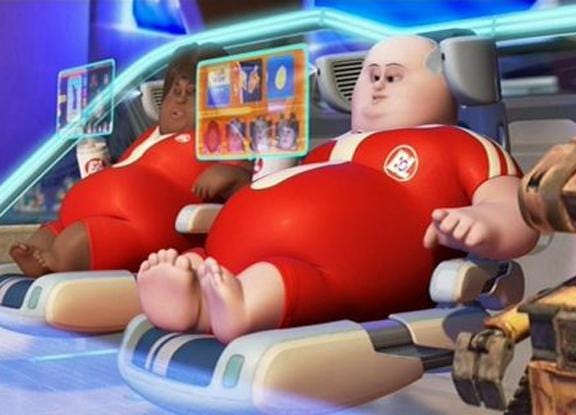
Neil Postman saw this coming forty years ago in his landmark Amusing Ourselves to Death. He wrote:
In 1984…people are controlled by inflicting pain. In Brave New World, they are controlled by inflicting pleasure. In short, Orwell feared that what we hate will ruin us. Huxley feared that what we love will ruin us.
If machines take over more of the work Boxer used to do (and they sure as hell look to), Huxley’s world is much more likely than Orwell’s. Some will win a false utopia within the friendly confines of drugs and degeneracy. Others will end up somewhere dystopic like the Savage Reservation, outside the system and mostly forgotten by it. Look no further than John the Savage to see what that portends.
We’re not yet living in Brave New World. Still, I spend hours on end, each and every day, on things designed to feel good while asking nothing of me. More still, the prospect of mass replacement by AI quietly haunts the dreams of the white collar world.
Huxley set his story about six hundred years out.
I’m not entirely sure we’ll last that long.
Per my about page, White Noise is a work of experimentation. I view it as a sort of thinking aloud, a stress testing of my nascent ideas. Through it, I hope to sharpen my opinions against the whetstone of other people’s feedback, commentary, and input.
If you want to discuss any of the ideas or musings mentioned above or have any books, papers, or links that you think would be interesting to share in a future edition of White Noise, please reach out to me by replying to this email or following me on X.
With sincere gratitude,
Tom