

If you’re not confused, you’re not paying attention. —Tom Peters
Remember When a Stranger Calls?
The phone keeps ringing.
The voice keeps whispering, Have you checked the children?
The babysitter keeps her composure until the police deliver the grim news: The call is coming from inside the house.
That’s humanity with AI.
Unlike the barbarians, the bots aren’t at the gate; they’re already upstairs, making themselves at home by rewriting our spreadsheets and slide decks while we scroll to our heart’s content.
Much like oxygen, artificial intelligence is invisible yet everywhere.
Today is the dumbest our mechanical models will ever be.
Tomorrow they will know more of our habits, mimic more of our quirks, and inch closer to a passable (though unembodied) copy of each and every one of us. In this world, where machine reigns supreme over man, the gap between imagination and execution will have been bridged—the only limit will be nerve.
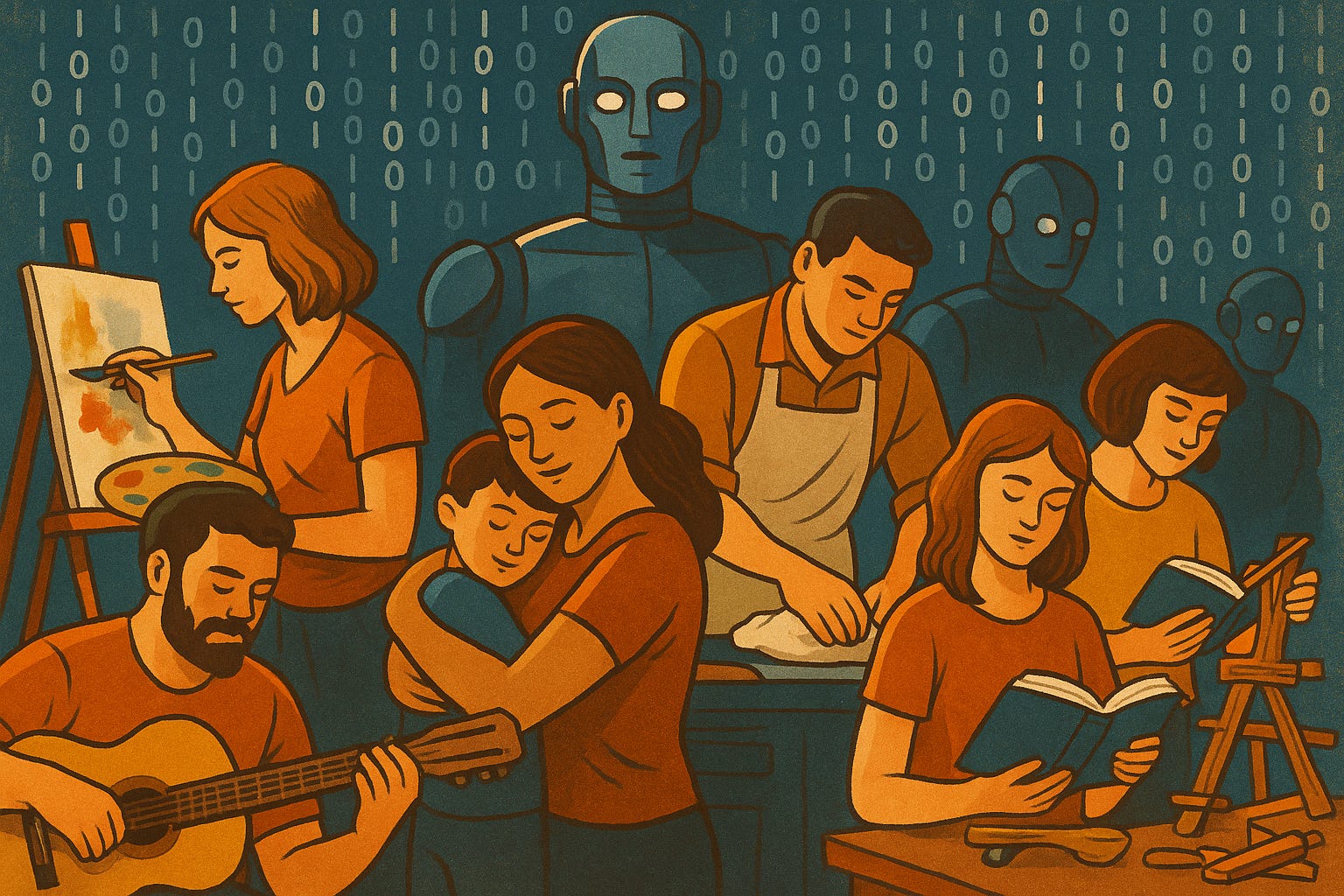
So how do we stay unmistakably, irreducibly, blood-sweat-and-tears human while software does everything else? What is truly antifragile in a world of artificial intelligence?
Below are some heuristics that come to mind:
EQ > IQ | Empathy is priceless when logic is a commodity.
Taste > Execution | Done is now table stakes, taste gets noticed.
IRL > URL | Presence forges memories no cloud can cache.
Atoms > Bytes | Hands-on projects anchor us in a sea of pixels.
Ideas > Outputs | One good design eclipses a thousand auto-drafts.
Why > How | Purpose steers tactics that change as often as the weather.
Questions > Answers | Good queries remain fresh long after facts go stale.
Direction > Speed | Rockets need a vector, not just thrust.
Trust > Code | Reputation cannot be cloned, forked, or open-sourced.
Attention > Information | Focus is a godsend in a world of hellish distraction.
Learning Rate > Skill Set | Adaptability survives every software update.
Double down on what silicon cannot fake, and let bits and bytes handle the rest.
Per my about page, White Noise is a work of experimentation. I view it as a sort of thinking aloud, a stress testing of my nascent ideas. Through it, I hope to sharpen my opinions against the whetstone of other people’s feedback, commentary, and input.
If you want to discuss any of the ideas or musings mentioned above or have any books, papers, or links that you think would be interesting to share on a future edition of White Noise, please reach out to me by replying to this email or following me on Twitter X.
With sincere gratitude,
Tom
Love this tom. But please tell me the graphic at the top isn’t AI-generated..
I don’t see why each one of those eleven rules could not be reversed by AI. In fact, with the growth of digital technology, there has been an increase in data-driven behavior over uniquely human behavior. Not to be as negative as you are optimistic, but couldn’t you just as validly argue the opposite? Flip all the greater-than signs? I do think that human attributes are more robust and less fragile than mechanistic ones, and that what makes us human is older and will last longer. But I would not underestimate the ability of the tech bros to manipulate and exploit our humanity to mechanistic ends. Apple, for instance, is more deeply integrating AI into all its systems, and relying on user behavior to inform it. At some point, the distinction between what is uniquely human and what is data-driven mimicry will fade. And this will erode our trust in the relevance of human individuality and authenticity. We won’t know who or what to trust.