

The purpose of abstraction is not to be vague, but to create a new semantic level in which one can be absolutely precise.
—Edsger Dijkstra
The first principle is that you must not fool yourself and you are the easiest person to fool.
—Richard P. Feynman
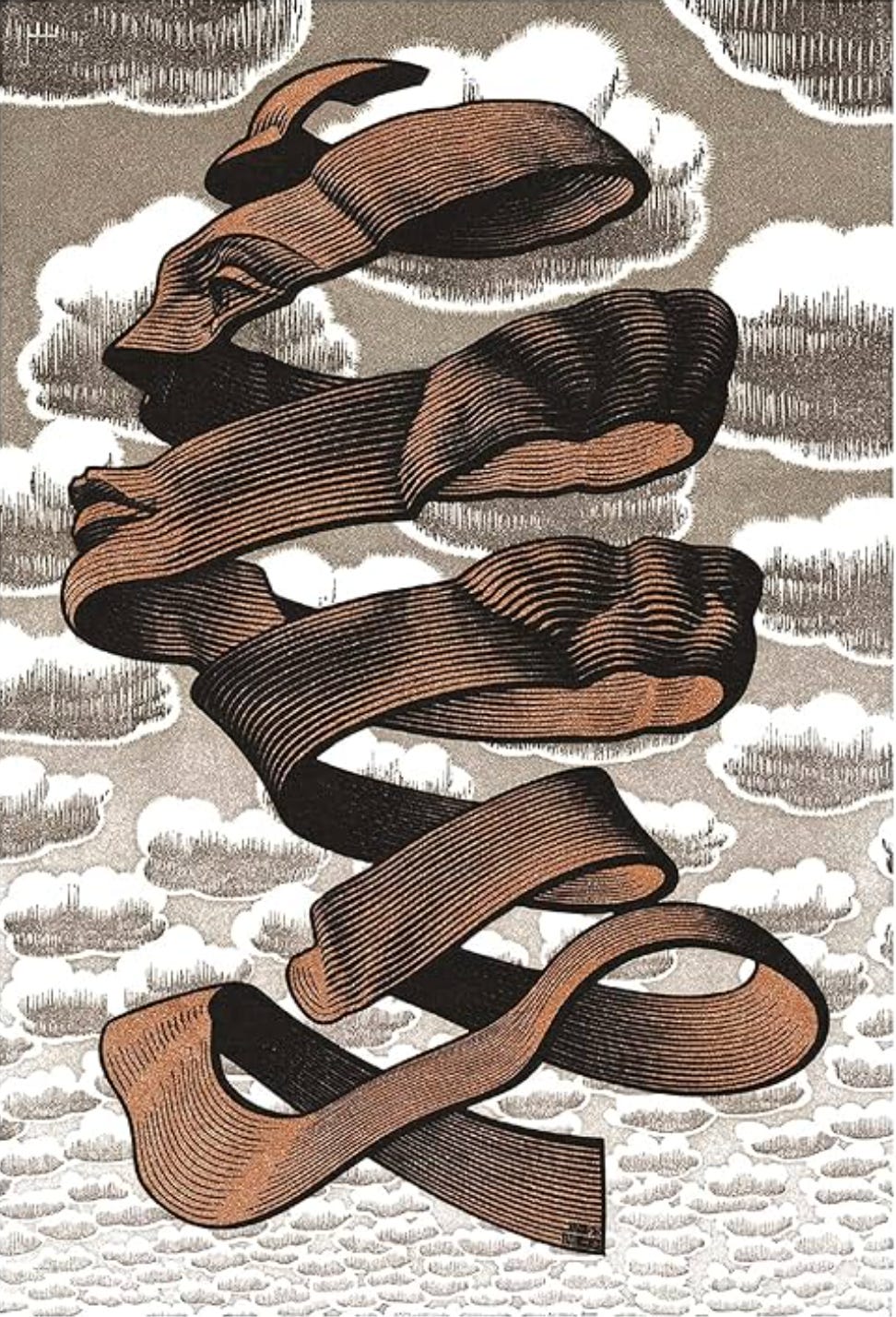
Above: Was all that juice worth all that squeeze?
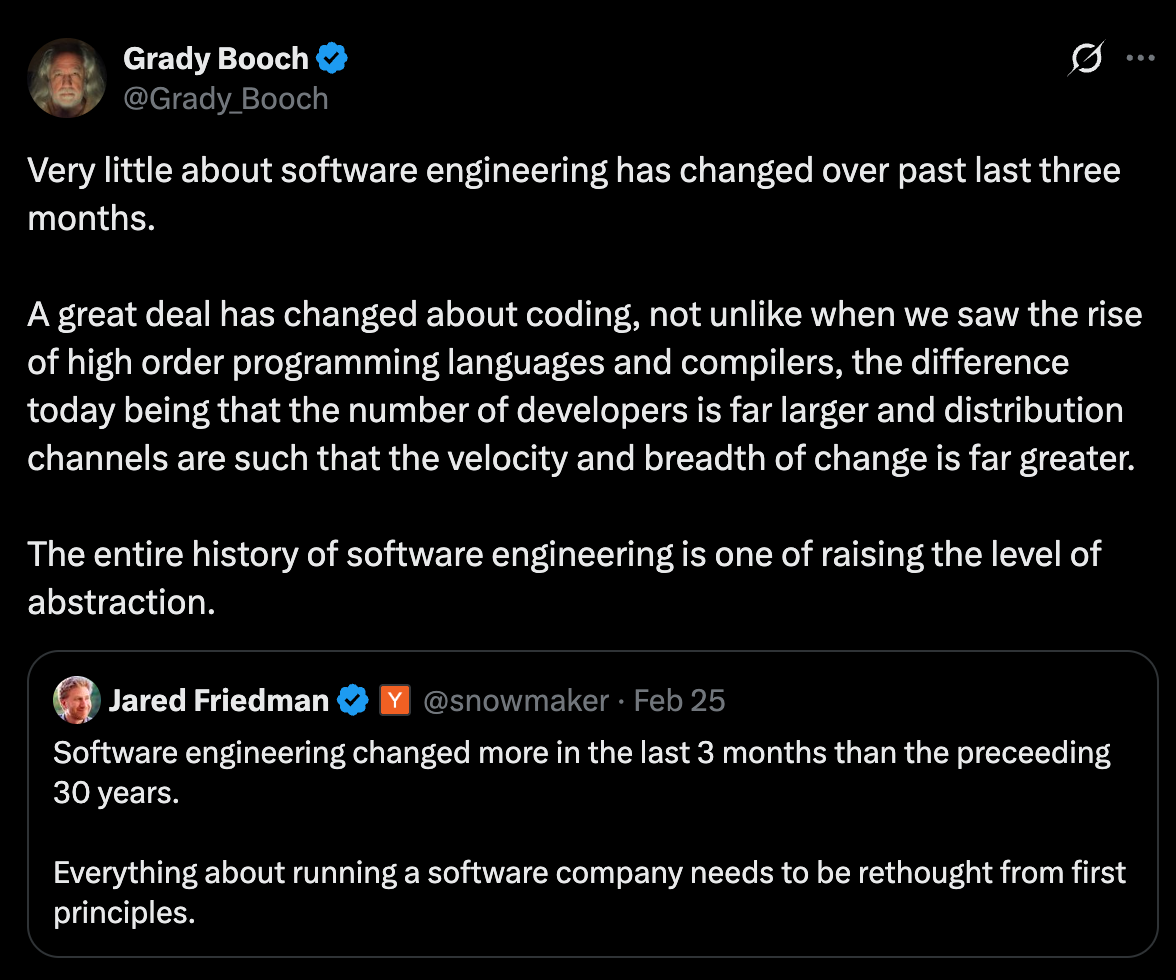
IBM Fellow and co-creator of UML Grady Booch recently posted this on X:
Ones and zeros became assembly.
Assembly became high-order languages.
Languages became frameworks.
Frameworks became prompts.
Each layer moved the engineer further from the machine and closer to pure intent.
In January, Nvidia CEO Jensen Huang gave this idea a much sharper edge:
Every job, he said, has tasks and purpose.
A radiologist’s task is studying scans. Their purpose is diagnosing disease.
A lawyer’s task is reading contracts. Their purpose is protecting clients.
A software engineer’s task is writing code. Their purpose is solving problems.
AI doesn’t eliminate the purpose. It simply abstracts away the task.
That distinction, task versus purpose, is the cleanest lens I’ve found for understanding what’s actually happening right now. Not just in software, but everywhere.
It's a comforting framework. Reassuring, even. The task gets automated, the purpose stays human. Everyone wins.
But it belies a deeper, darker question: what if the task was how you learned the purpose in the first place?
The radiologist who never studied a scan can't diagnose the disease.
The lawyer who never read a contract can't protect the client.
The task was never just a task. It was the very training ground.
Viewed this way, it's hard to feel entirely good about the fact that the entire history of life is one of raising the level of abstraction.
Across domains, relationships, and basic human actions, we’ve been peeling ourselves away from direct experience so gradually that we barely register the distance.
Each new layer promises convenience, scale, efficiency.
But this comes at great cost, as it removes a little more of us from the thing itself:
Cooking a meal versus ordering from a menu versus tapping UberEats.
Speaking in person versus making a phone call versus sending a text.
Shaking hands versus signing a document versus clicking DocuSign.
CLI versus GUI versus chatbot.
Tutoring a student versus recording a lecture versus publishing a course on Udemy.
Whittling wood versus operating a lathe versus sending a file to a 3D printer.
Knowing your neighbor versus joining a community Facebook group versus checking Nextdoor.
Tasting the sauce versus reading the recipe versus asking ChatGPT what’s missing.
Playing catch with your kid versus signing them up for a league versus tracking their stats in an app.
Haggling at a market versus comparing prices online versus letting a bot auto-buy at the lowest price.
Writing a letter of recommendation versus filling out a reference form versus clicking “endorse” on LinkedIn.
Navigating by landmarks versus reading a map versus following the blue dot on Google Maps.
Tuning a guitar by ear versus using a tuner clip versus using an app that auto-corrects pitch.
Confessing to a priest versus journaling versus typing into a therapy chatbot.
Reading a room versus sending a survey versus running sentiment analysis on Slack messages.
Picking fruit from a tree versus buying it at a farmer’s market versus subscribing to a meal kit service.
Dancing with someone versus swiping right versus letting an algorithm pick your match.
Arguing face-to-face versus writing an email versus letting AI draft your reply.
Fixing a leaky faucet versus calling a plumber versus submitting a request on TaskRabbit.
Mourning together at a funeral versus posting a tribute on Facebook versus letting your phone auto-generate a memory video.
If you want to see what life looks like at abstraction ground zero, watch a man spend six months making a sandwich entirely from scratch:
Total cost: $1,500. Result? Just okay.
We should be grateful for what convenience gives us. But we should also consider what we lose when we're this far from the realities of life.
Abstraction, like time, only moves in one direction. It promises to free us from the task so we can focus on the purpose. But something happens when the layers stack too high. We stop knowing how to do the thing we’ve been freed from. Then we stop knowing we ever could. The snake of abstraction eats its own tail and, in doing so, it swallows competence whole. This is the quiet danger of the cult of efficiency: not that we lose our jobs, but that we lose our capacity to do them.
Every layer of abstraction saves you effort. But convenience has a cost.
You.
Per my about page, White Noise is a work of experimentation. I view it as a sort of thinking aloud, a stress testing of my nascent ideas. Through it, I hope to sharpen my opinions against the whetstone of other people’s feedback, commentary, and input.
If you want to discuss any of the ideas or musings mentioned above or have any books, papers, or links that you think would be interesting to share in a future edition of White Noise, please reach out to me by replying to this email or following me on X.
With sincere gratitude,
Tom
Excellent list of examples.
Really solid perspective. We can use AI as a tool but we cannot let it take away our purpose!