

If thought corrupts language, language can also corrupt thought.
—George Orwell
Don’t you see that the whole aim of Newspeak is to narrow the range of thought? In the end we shall make thought-crime literally impossible, because there will be no words in which to express it. Every concept that can ever be needed will be expressed by exactly one word, with its meaning rigidly defined and all its subsidiary meanings rubbed out and forgotten.
—George Orwell
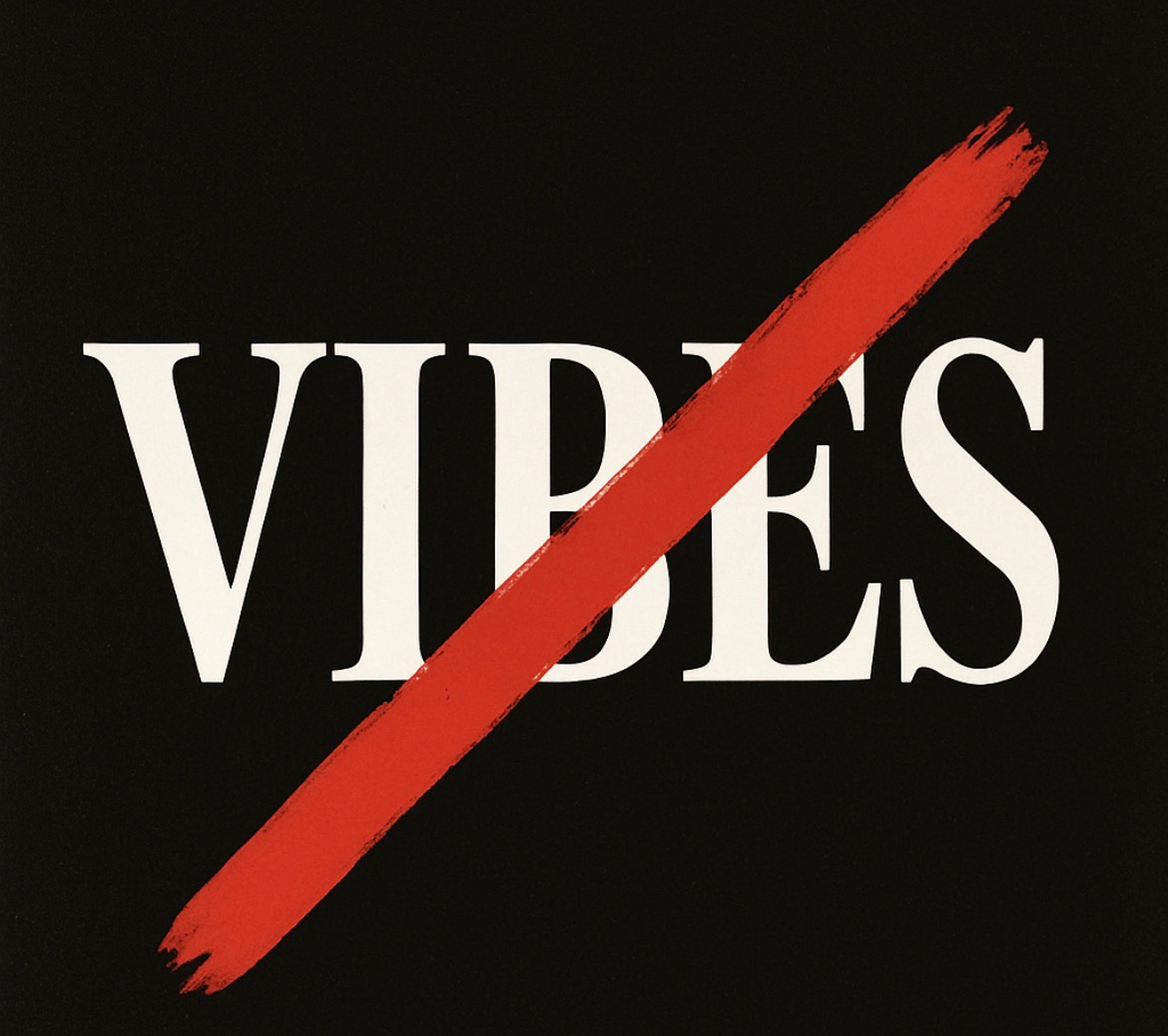
Above: Hang this in every classroom on planet Earth.
Somewhere along the line, we started talking like everything was an aesthetic choice instead of an experience.
We used to say this feels wrong, or I don’t trust her, or something about this is bothering me and I can’t put my finger on it but I’m going to try. Now, unfortunately, we just shrug and go: “the vibes were off.”
And somehow that passes for intelligent conversation, for meaning.
I know how this sounds. Cue the Simpsons meme:
But I’d rather yell at a cloud than pretend that flattening emotion into a monosyllabic mood descriptor is normal.
Because it isn’t.
It’s part of a cultural slide into mush.
It’s the linguistic version of this image charting dominant colors in photography over time:
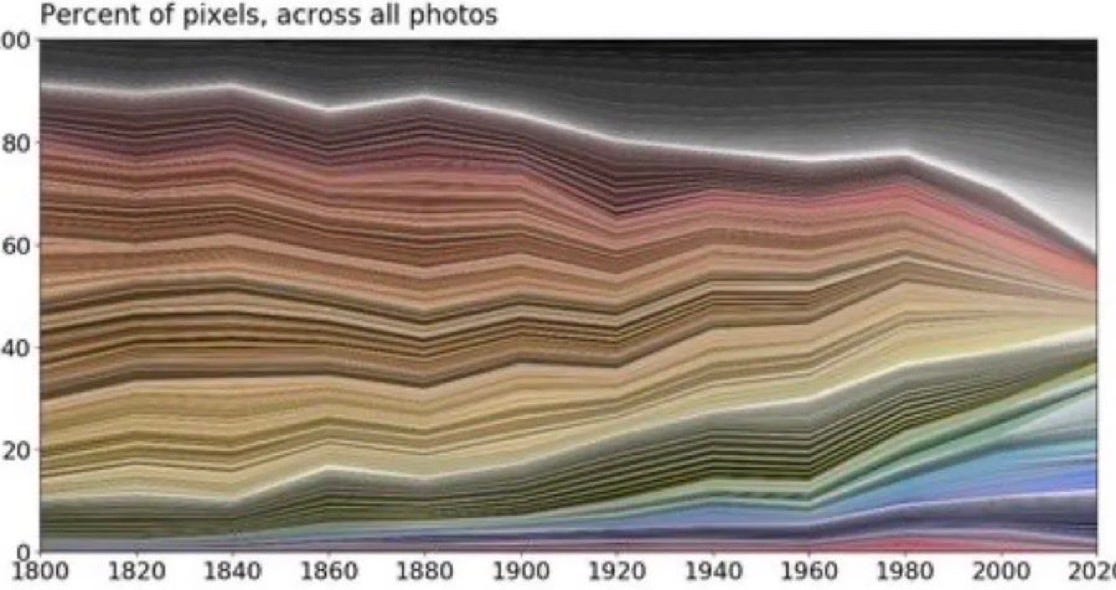
Everything used to be bold, sharp, high-contrast, and then, as history lurched forward, the palette slid into grays, taupes, rental-apartment sage greens, and influencer-approved oatmeal.
These are two sides of the same coin.
Vibes is no more than ambiguous, emotional beige.
It’s a placeholder for thought. A verbal shrug. A smudge where a sentence should be.
It’s bringing a dull, plastic knife to a linguistic gunfight.
It’s perfectly designed for a world where meaning collapses into shareable mush.
It’s nonspecific enough to be universal, breezy enough to signal you’re in on the joke, and vague enough to avoid the discomfort of saying what you actually feel.
The Rise of Vibe-Speak
Today:
A restaurant isn’t delicious — it’s good vibes.
A relationship didn’t fail because of incompatibility — the vibes just shifted.
A person isn’t manipulative or unreliable — they have weird vibes.
Notice what disappears:
Responsibility
Clarity
Specificity
Reality
Vibe-speak lets us avoid saying what we mean while pretending we have.
It’s aesthetically pleasing indecision, a filler word whose meaning is left up to the interpretation of the listener, like a flag that flaps whichever way the wind blows.
Why We Choose It
Real words demand courage.
If you say:
“I’m overwhelmed.
“I felt disrespected.”
“I don’t trust him.”
—something becomes true.
But if you say:
“The vibes are off.”
Nothing is risked.
No detail can be challenged.
No feeling must be defended.
No self must be revealed.
Vibes aren’t language, but plausible deniability.
Because specificity is intimate. Specificity is accountable. If I say “the vibes were weird,” you can’t misunderstand me. You can’t ask for proof.
But if I say, “I felt dismissed when you interrupted me” now I have to stand inside the truth of that sentence.
To be clear, I’m against neither slang nor play. However, I am very much against dissolving into abstraction so fully that we forget how to recognize our own emotional fingerprints.
Use the word if you must, but don’t stop there.
If something feels off—ask why.
If something feels electric—call it out.
If something feels unbearable, thrilling, humiliating, sacred—use your language like it matters.
Because it does.
“A Theory of Dumb” from New York Magazine said it plainly:
The stigma that was once attached to ignorance has disappeared, and the loudest and least informed voices now shape the conversation, forcing everyone else to learn to speak their language…
We’ve become so accustomed to this churn that much of what we know, or think we know, now consists of confabulations that have built up over years. The collective knowledge base has been overwritten with received wisdom, fourth-hand opinions, and counterintuitive pop social science that flatters our cleverness while sparing us the effort of understanding anything deeply. In an increasingly complex world, the metaphors we use to explain it keep getting cruder. Any process that turns anything to crap is “enshittification.” Every aesthetic is a “core.” The ad-driven, data-powered personalization system that rules our lives is “the algorithm.” Anything that can’t be explained via one of the above is simply “vibes.”
So we shrink.
We compress.
We “yap.”
And so much gets lost in truncation.
We swap articulation for atmosphere:
energy
core
aesthetic
feels
mood
67 (don’t even get me started)
And when that fails?
We just call it vibes.
We’re not simplifying; we’re surrendering.
And yet, maybe people aren’t avoiding complex language because they’re stupid. Maybe we’re just exhausted.
We live in a world optimized for scrolling, not thinking; for reacting, not reflecting; for clips, not quips.
We’ve learned to speak like content and vibes is perfect for that world: frictionless, vague, shareable, consequence-free.
To name something is to confront it.
To describe something precisely is to understand it.
To speak honestly is to exist fully.
Vibes ask nothing.
Reveal nothing.
Risk nothing.
They float.
They fade.
They never land. Instead, on a long enough time horizon, they come crashing down because things left unsaid tear relationships apart.
Say the Damn Thing
People think precision is pretension. They think naming a feeling is overthinking it. They think specificity is dramatic. They think articulation is exhausting.
But naming things — naming your inner state — isn’t performance. In fact, it’s the one of the only things left that separates us from machines.
Ted Gioia said it well:
Who wants to hear a bot sing of love it has never experienced? Who wants a nature poem from a digital construct that exists outside of nature? Who wants a painting made by something with no eyes to see?
The world doesn’t need fewer emotions, it needs fewer euphemisms.
Use words with edges.
Use words that cost something.
Words that can cut and mark and bleed.
Say:
“This matters.”
“I want this.”
“I’m afraid.”
“I care.”
“I need you.”
“I’m overwhelmed.”
“I disagree.”
“I’m angry.”
“That hurt.”
“This isn’t working.”
“I love you.”

Let language sharpen you, don’t dissolve into vagaries.
Because if everything becomes vibes, nothing becomes true.
And the point of being alive isn’t to speak like fog or fade into the mist, but to act like someone who’s actually breathing.
Per my about page, White Noise is a work of experimentation. I view it as a sort of thinking aloud, a stress testing of my nascent ideas. Through it, I hope to sharpen my opinions against the whetstone of other people’s feedback, commentary, and input.
If you want to discuss any of the ideas or musings mentioned above or have any books, papers, or links that you think would be interesting to share on a future edition of White Noise, please reach out to me by replying to this email or following me on Twitter X.
With sincere gratitude,
Tom
People do this because they seek to avoid judgment. Either being judged for their words and choices or being judgmental. That's the original sin, we've ruled that any kind of discernment is out of bounds.
I wrote your quote as a keeper: “And the point of being alive isn’t to speak like fog or fade into the mist, but to act like someone who’s actually breathing.” It is almost rare these days to arrive animated and conversational amidst those checking their screens and disappearing into the fog of angst and neuronothingness except for their experienced feed. Language is such a beautiful terrain and to reduce its diversity and complexity would limit our capacity immensely.