

The most regretful people on earth are those who felt the call to creative work, who felt their own creative power restive and uprising, and gave to it neither power nor time.
—Mary Oliver
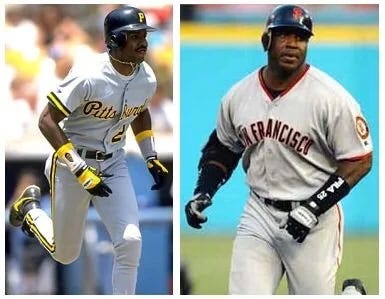
Above: You versus You + AI.
Barry Bonds hit 762 home runs. More than anyone who ever lived, but it doesn’t matter.
It doesn’t matter because of the asterisk. Because he played in an era when the game’s sacred records were brusquely rewritten by men whose bodies were science fair projects. Though Bonds never failed a drug test, McGwire admitted it; Sosa got caught with a corked bat; and Clemens went to Congress and lied under oath.
The whole era was poisoned, and if you played in it and put up numbers, you were guilty until proven innocent. Except there was no proving innocent. The question hung over everyone. Clean or not, you carried with you the heavy, spiked yoke of the asterisk.
Forget the overt cheaters, the real cruelty was what happened to the guys who didn’t cheat. Their honest numbers looked small next to inflated ones. They got passed over or cut. They played clean and were punished for it, because purity was a competitive disadvantage in a game that had already decided the rules didn’t apply anymore.
I think about this constantly when I see how writers and artists and filmmakers talk about AI.
The fear most people name is the wrong one. They say they’re afraid AI will replace them. That’s plausible enough to resist, and this puritanical fight feels somewhat productive
However, if you lean in close and close your eyes tightly, you’ll begin to discern the actual fear. It’s much quieter and it too takes the form of the asterisk.
Imagine you are an aspiring playwright, novelist, or director. You’ve been carrying ideas around for years. Tendrils of things. The novel in the form of three chapters in a Notes app. The business plan scrawled on a map of scrunched up cocktail napkins. The essay that keeps rewriting itself in the shower. You never ship them. Life, fear, timing, whatever; for some reason, they stayed inside.
Now AI arrives, and the cost of pulling those tendrils out of you and into the world drops to nearly nothing. So, one day, you finally do the damn thing.
And then, like the very worst intrusive thought you’ve ever had, the question appears. Not from a critic. Not from X. From inside your own head.
Was it you?
Were you the X factor, the reason the thing exists?
Or were you just an input, a warm bag of bones at a prompt window?
Without the machine would those small fragile thoughts still be nestled in the safety of your creative womb?
Maybe it’s neither extreme. Maybe the thing you made is some Ship of Theseus where AI’s planks got swapped in so gradually that nobody, including you, can point to where you end and the tool begins.
That’s the AI asterisk. And it’s worse than the steroid version because at least in baseball, you could theoretically test for the drugs. There is no test for AI contamination. There’s no blood sample for whether the sentence you just wrote was yours or whether your favorite author has now become a purveyor of slop or whether you’re unconsciously reproducing a pattern you absorbed from a thousand ChatGPT outputs.
The asterisk need not be applied to your work. It’s something that now exists in the atmosphere. You breathe it in whether you use the tools or not. And, like radiation, repeated exposure slowly kills you.
I’m starting to think the asterisk is a different animal than slop.1
Slop is a question of effort. The asterisk is a question of identity.
It’s the anxiety of tainting, of contamination by proximity or proxy. You didn’t get the work out before AI arrived, and now you can’t prove it was ever fully yours. Maybe you weren’t the independent variable. Maybe you were just a cog, some input, and without the machine those tendrils would still be undeveloped and unseen, rattling around your skull until you died.
Or maybe it’s worse still. Maybe the finished thing is some vague, hybrid centaur where no one, including you, can tell where the AI stops and you start.
The cheater and the clean player look identical in the box score. But the guilty, the innocent, and the collective jury each know the difference.2

As I wrote recently, Josef Pieper saw something adjacent decades ago:
Man seems to mistrust everything that is effortless; he can only enjoy, with a good conscience, what he has acquired with toil and trouble; he refuses to have anything as a gift.
We built our current creative culture on a foundational theology of suffering. If it didn’t cost you something, it doesn’t count. AI makes things feel effortless even when they aren’t, and that’s enough to trigger suspicion.
The steroid era eventually ended. Sort of. Baseball cleaned up its testing, adjusted its culture, and moved on. But the records still have the asterisk. Bonds is still not in the Hall of Fame. Far from fixed, baseball just limped on until the era was relegated to the rearview mirror.
That’s the only honest thing I can say about this moment. You’re not going to outrun it. There is no shipping your work into a world where AI doesn’t exist. The atmosphere has changed. The question will always be available to anyone who wants to ask it, including you.
So you have a choice. You can hold your ideas hostage until the air clears. It won’t. The mist is here to stay and the sun has been forever blotted out.
You can kill the tendrils to keep them pure. That’s the Barry Bonds solution in reverse: refusing to step up to bat because the game is dirty.
Or you can make the thing.
Let the asterisk exist. Let people wonder. Let the question hang.
The tendrils in your head don’t care about provenance.
They just want to exist.
Per my about page, White Noise is a work of experimentation. I view it as a sort of thinking aloud, a stress testing of my nascent ideas. Through it, I hope to sharpen my opinions against the whetstone of other people’s feedback, commentary, and input.
If you want to discuss any of the ideas or musings mentioned above or have any books, papers, or links that you think would be interesting to share in a future edition of White Noise, please reach out to me by replying to this email or following me on X.
With sincere gratitude,
Tom
“The problem with slop isn’t the slop. It isn’t even the fact that AI was used. After all, tools don’t commit crimes; people do. The problem with slop (especially in writing) is that the writer doesn’t care enough about the reader to make the reader’s life easier.” From Slop Is Contempt.
To be clear, I'm not saying that using AI is cheating. But everything in moderation, including moderation.
Love this analogy. Would the AI equivalent being brains getting all swollen and top heavy for bodies as people walk around with heads tilted for being too heavy for their necks given the unnatural intelligence increase? At any rate, great point and interesting when thinking about what the future holds both for the creator class and for sports. At some point we surely just stop writing the asterisk.
I remember that season when, all of a sudden, Mark McGuire, Barry Bonds and Sammy Sosa were hitting 70 or so home runs. So much for Roger Maris hitting 61 in '61! I was unhappy about this arms race because we all probably knew that it was fueled by fakery. Later, my daughter and I used to love watching Lance chew their balls off as he effortlessly tapped on the pedals up the Alp d'Huez. If we had been honest with ourselves, it could have been seen that they were all on the take. And you can't spell asterisk without "take" either. Moral of the story: don't put your idols on too high a pedestal because their fall will be Earth-shattering. Will AI fall from its pedestal, or will it use that position to stomp humanity into the dust?