

Writing is an act of faith, not a grammar trick.
—E.B. White
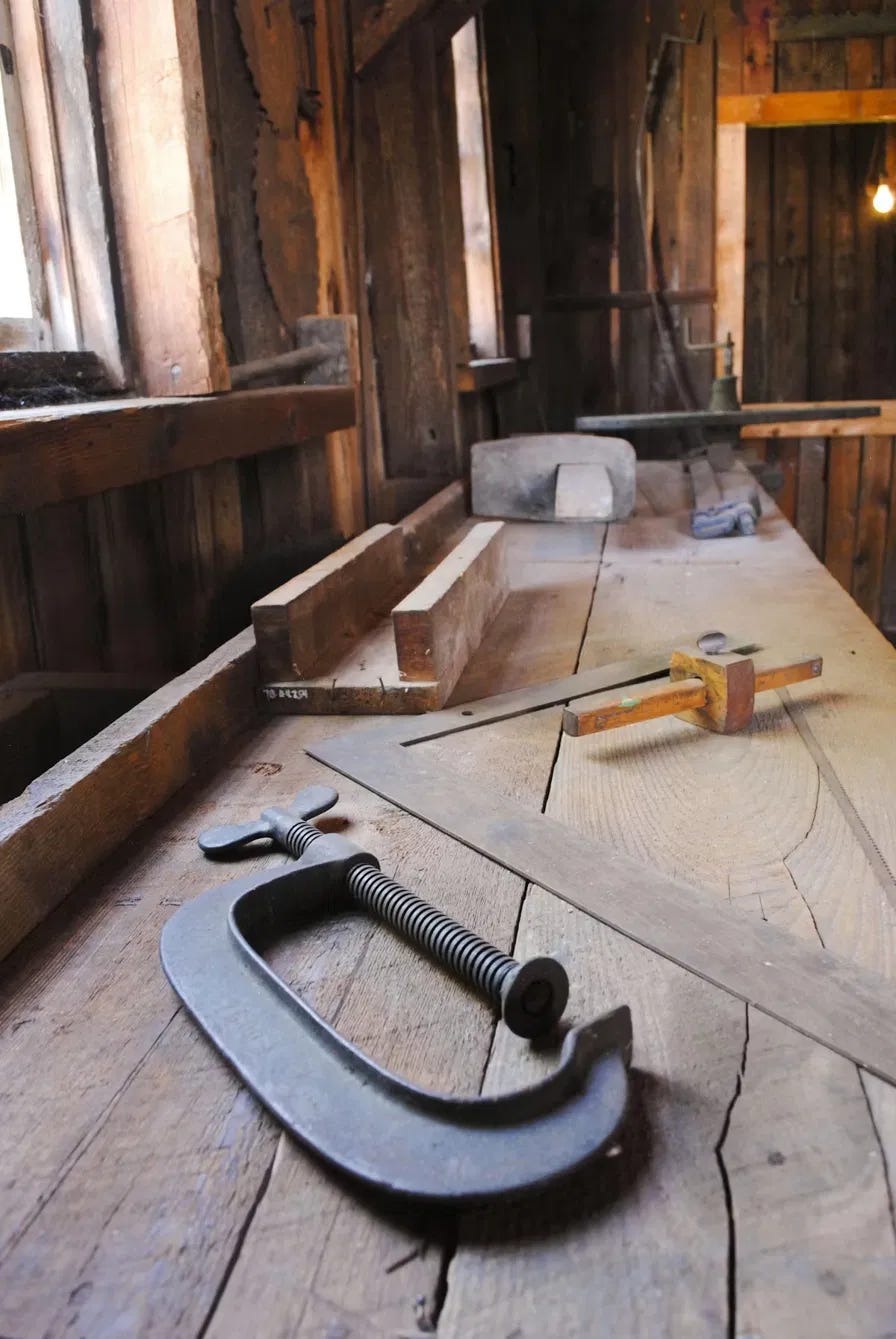
The WordWorker was a quiet, odd sort of fellow.
Stooped in stature, he spent a good part of his days hunched over paper and pencil. He sanded sentences until they were smooth, polished paragraphs until they popped.
His shop sat at the end of a crooked lane, between a clockmaker who had forgotten the time it was and a baker who had forgotten the flour. A wooden sign hung above his door. It said nothing at all because the very best signs made you stop and read them twice.
Inside, the air smelled of cedar and ink and something older, like the inside of a library nobody had visited in a long while. Shelves climbed the walls, sagging under the weight of countless jars. Some held adjectives, sorted by temperature. Others held verbs, the restless ones rattling against the glass. He kept his nouns in drawers because nouns liked to be alone. The adverbs he kept in a tin box on a high shelf that he only opened when he had to.
He worked at a bench scarred by decades of revision. His tools hung on the wall in careful rows. A plane for shaving down sentences that had grown too proud. A chisel for prying loose the wrong word from a paragraph that had already begun to harden. He had a level too, though most days he trusted his ear.
He hewed his words from thin air. That was the part people did not understand. They thought a word was a word, the way a board is a board, and you simply went to the shop and bought one. But the WordWorker knew that a word came out of the air the way a deer comes out of a forest, quietly, and only if you were quiet too. He would stand at the open window for hours, listening, and then his hand would dart out and there it would be, the word, still warm, struggling a little, and he would carry it back to the bench and begin.
He took commissions. A widow once asked him for a single sentence to put on her husband’s stone. He worked on it for two weeks. When he gave it to her she read it once and sat down on the floor of his shop and wept for an hour, and then she stood up and paid him and went home, and he never knew which of the two reactions had been the compliment.
A boy came in asking for a love letter. The WordWorker asked him what the girl was like. The boy talked for twenty minutes. The WordWorker listened, then handed the boy a pencil and said, “Write it yourself, you already have.” The boy looked betrayed for a moment, and then thoughtful, and then he left without paying.
He had rules. He would not sell clichés, though he kept a barrel of them by the door for emergencies and gave them away free to anyone who looked desperate. He would not work in jargon. He would not, under any circumstances, use the word utilize. He kept a small jar on the windowsill for words he had retired, and utilize had been the first one in it, decades ago, and it sat at the bottom now with synergy and leverage piled on top of it like stones on a grave.
At night, when the shop was closed, he would sometimes take down a finished piece and run his fingers over it the way a carpenter runs his hand along the grain of a good plank. He was checking for splinters. A sentence with a splinter could draw blood from a reader, and the WordWorker did not believe in that kind of injury. If he found one he would sit back down at the bench and work the place smooth, even if it took until morning, even if no one would ever notice but him.
People asked him sometimes why he bothered. Words were cheap, they said. The air was full of them. Machines could make them now, faster than any man, in any shape you liked, for almost nothing.
He would nod at this, because it was true.
Then he would go back to his bench, and pick up his pencil, and begin again.
Per my about page, White Noise is a work of experimentation. I view it as a sort of thinking aloud, a stress testing of my nascent ideas. Through it, I hope to sharpen my opinions against the whetstone of other people’s feedback, commentary, and input.
If you want to discuss any of the ideas or musings mentioned above or have any books, papers, or links that you think would be interesting to share in a future edition of White Noise, please reach out to me by replying to this email or following me on X.
With sincere gratitude,
Tom
Thank you, Tom! You totally made my day! I am 76 years old and have been an editor most of my life. My favorite business card said “words are my business”. It has been a lovely life, and it sounds like your has been also / yay for us!
I could picture the cliches in a bucket by the door like the bucket by the paint shop's door that's filled with mixing sticks. Hehe. This is quite brilliant. In so many ways, writers are very much like shop guys- working alone and doing a lot of work but also a lot of thinking. I feel like I need to write in my garage from now on. Hehe. Outstanding post, Tom.