

A writer—and, I believe, generally all persons—must think that whatever happens to him or her is a resource. All things have been given to us for a purpose, and an artist must feel this more intensely. All that happens to us, including our humiliations, our misfortunes, our embarrassments, all is given to us as raw material, as clay, so that we may shape our art.
—Jorge Luis Borges
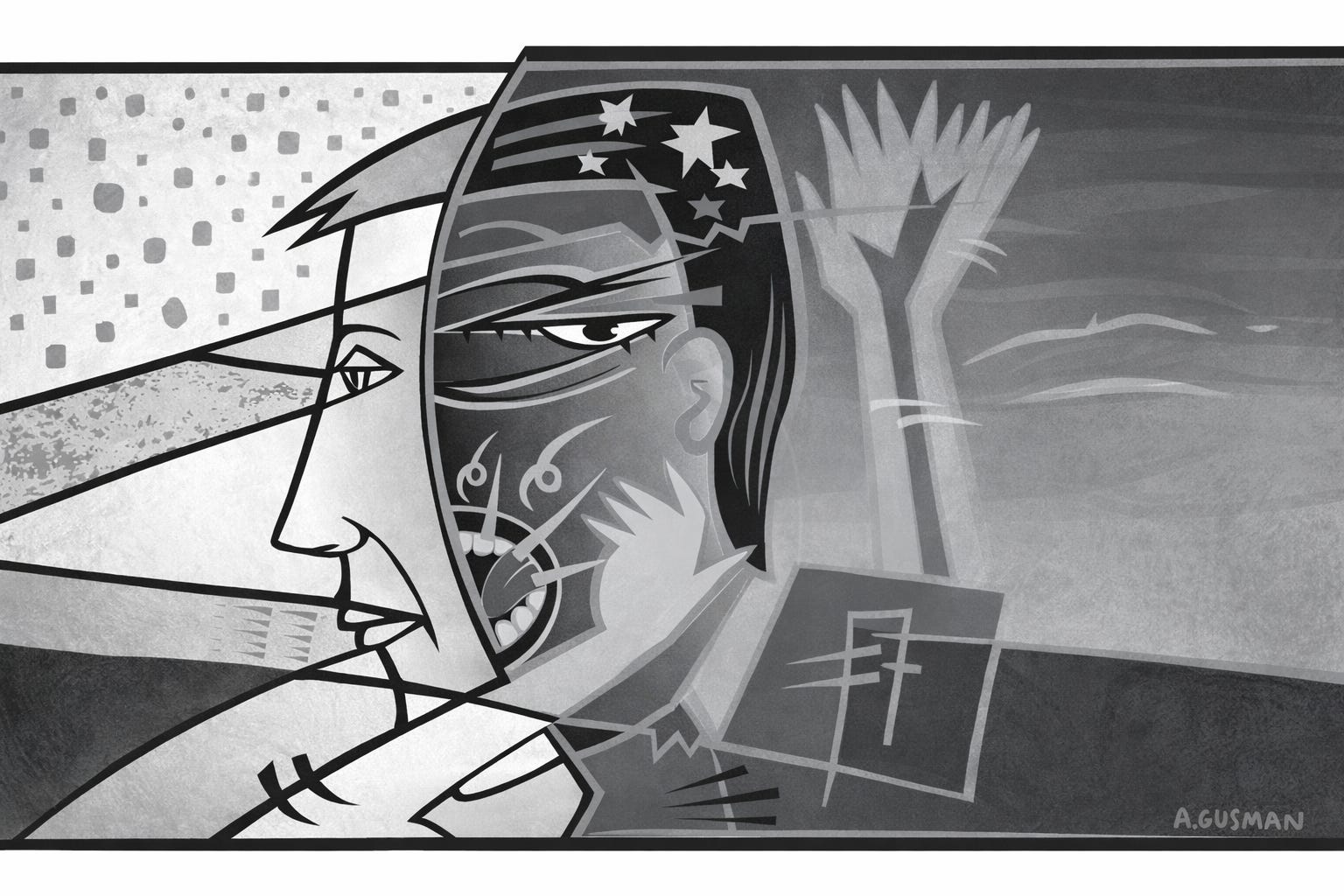
Every day, my spasms beget stares and my grunts give rise to gawks. I intimate from these expressions, gestures, and jeers—both spoken and unspoken—the following common questions:
“What are you doing?”
“Why did you do that?
“Are you okay?”
“What the hell?”
“What’s wrong?”
“What’s wrong with you?”
These questions and others like them puncture my days, deflate my demeanor, and punctuate my existence. All obliquely revolve around and touch upon the pernicious disorder with which I struggle on an unceasing, everlasting basis: Tourette syndrome.
Defined by the medical community as “a neurological disorder characterized by multiple motor and vocal tics lasting for more than one year,” Tourette syndrome encompasses everything from echolalia, the repetition of words, to coprolalia, involuntarily swearing. Although the media homes in on these components of Tourette, they only present in very few people.
Like John Davidson, I am one of the unlucky few afflicted with this regretful, rare manifestation.
I stand with him, a fellow winner of the genetic lottery from hell who has drawn the ire of the ignorant mob in the workplace, on public transit, in houses of worship, and every place where life is lived.
For people like John and me, tranquility is an abstract concept like freedom or justice.
Our minds are battlefields.
As a rule, war is hell and this one is no exception.
It rages across synapses and axons and soma and dendrites, its barren, pockmarked no man’s land illuminated by glowing barrages of dopamine and serotonin.
Unlike the Western Front, here it is never quiet.
Like shrapnel, anxiety whistles
Like gas, depression settles.
Like bayonets, nausea stabs.
Like officers, self-doubt reproaches.
Like shells, self-esteem falls.
Like mines, comfort lies buried.
Like bullets, fear pierces.
Like screams, emotions are stifled.
Like death, chaos is the only constant.
You see, Tourette is a chimera of a disorder. On one day, it can cause you to stomp, shriek, or shout about shit; on another, it simply makes you shuffle your shoes or spring spittle from your mouth. To me, it counts as one of the most unpredictable, inconsiderate, and inconsistent diseases that exists. There is neither rhyme nor reason to its variety of symptoms and no two people who suffer from it are alike.
What began for me in the third grade as simple eye twitches and facial grimaces has since become a cacophony of motor and vocal tics that constantly plague me. My syndrome takes the opportunity to behave inappropriately at the most inopportune moments. It is viciously creative, highly intelligent, and unbelievably perceptive; attacking those values you hold strongest by targeting the mind’s weakest fault lines.
Candidly, I don’t think it a coincidence that torture and Tourette are nearly anagrams. I wouldn’t wish it on my worst enemy.
To have Tourette is to live a life of controlled entropy. It is a careening, a hurtling through life, a mad dash not only to function, but also to keep neurological frenzy at bay.
It is a perpetual, desperate fight to keep outer order despite inner uproar.
It is a volatile sanity, an outlandish existence, a rush of frantic energy that can neither be controlled nor properly harnessed. It is a flubbing and fat fingering through life; one of harried chaos and of jostlings that constantly threaten to interrupt thoughts, words, movements, and existence, itself.
It feels like life lived at the precipice, the intersection of control and chaos; that subconscious, instinctual realization when you know you’ve arrived at the proverbial edge.
It is the skier careening downhill, narrowly missing a tree or ridge.
It is the child unsteadily learning to ride a bicycle, knowing that a crash and a bloodied knee are imminent.
It is the duckling projecting an image of serenity while pedaling furiously under the water’s surface.
It is the soldier, prone in his foxhole, trembling as bullets zip and whiz all around him.
It is death by a thousand turbulent minutiae; a life lived as a perpetual accident on the road about and around which people rubberneck.
It is an existence powered by Samuel Beckett’s prayerful hymn of “I can’t go on. I’ll go on.”
By themselves, most individual tics aren’t injurious or harmful. However, much like water slowly dripping onto and eroding rock, over time they inflict serious damage. They compound and slowly drive the afflicted to exhaustion, frustration, and acquiescence.
But the erosion is not only internal.
The tics are burden enough. What makes them unbearable is the world’s reaction to them. The stares. The whispers. The seat left empty beside you on a crowded train. The invitation that never comes. The employer who finds a reason. The family member who suggests you “sit this one out.” The quiet, cordial, well-meaning suggestion that maybe you’d be more comfortable at home: out of sight and out of mind.
This is the unspoken cruelty of Tourette: it is a disease of the onlooker. The afflicted suffer twice—once from the disorder itself, and again from a world that would rather look away than look closer, segregate rather than accept. People don’t recoil from the syndrome. They recoil from their own discomfort. And rather than reckon with that discomfort, they quarantine the source.
I hate my Tourette. I would give an arm for it to be gone. Both arms. My legs. My net worth. Everything I own and everything I am. I would trade it all for a single quiet moment inside my own skull.
But I can’t. So I ask for something far cheaper: mercy. A little of it goes a long way, particularly when all other maladies are afforded compassion that Tourette is not.
No one asks a person in a wheelchair to “just stop.”
No one tells someone with epilepsy to “try harder.”
No one asks a person with Alzheimer’s to “just remember.”
Yet the Tourettic is expected to suppress, to apologize, to make himself smaller so that others might feel larger.
To quote the providentially-titled, sorely-needed film, I Swear: “Maybe the problem isn’t Tourette’s maybe the problem is people don’t know enough about Tourette’s.”
As Publilius Syrus said in his Sententiae, “Pain of mind is worse than pain of body.” As one who knows mental and physical pain, I can say that the ache of a broken brain throbs more acutely than that of a broken bone.
No matter.
Despite ignorance, despite enmity, despite misunderstanding, despite malice, by God, I shall keep fighting.
For more on Tourette:
Standing Firm— A chronicle of my experience as a Tourettic ballboy at the U.S. Open
A Glaring Problem— A lively reflection on the outset of my time with Tourette
Tourette Does the Talking— A TEDx Talk narrating my life with Tourette
Per my about page, White Noise is a work of experimentation. I view it as a sort of thinking aloud, a stress testing of my nascent ideas. Through it, I hope to sharpen my opinions against the whetstone of other people’s feedback, commentary, and input.
If you want to discuss any of the ideas or musings mentioned above or have any books, papers, or links that you think would be interesting to share in a future edition of White Noise, please reach out to me by replying to this email or following me on X.
With sincere gratitude,
Tom
Much love to one of the best humans and minds I know. I'd take that empty seat next to you and would always fight for you to keep your seat at work. Count me as one of the many in your corner and ready to support at any time.
Tom, you have a stunning ability to reach beyond words into people's minds, and hearts, and souls. There is a part of the world that reacts to your Tourettes, and there is a part that reacts to your genius. From my point of view, to hell with the first part. Keep writing and creating!