

Today you are you, that is truer than true.
There is no one alive who is you-er than you.
—Dr. Seuss
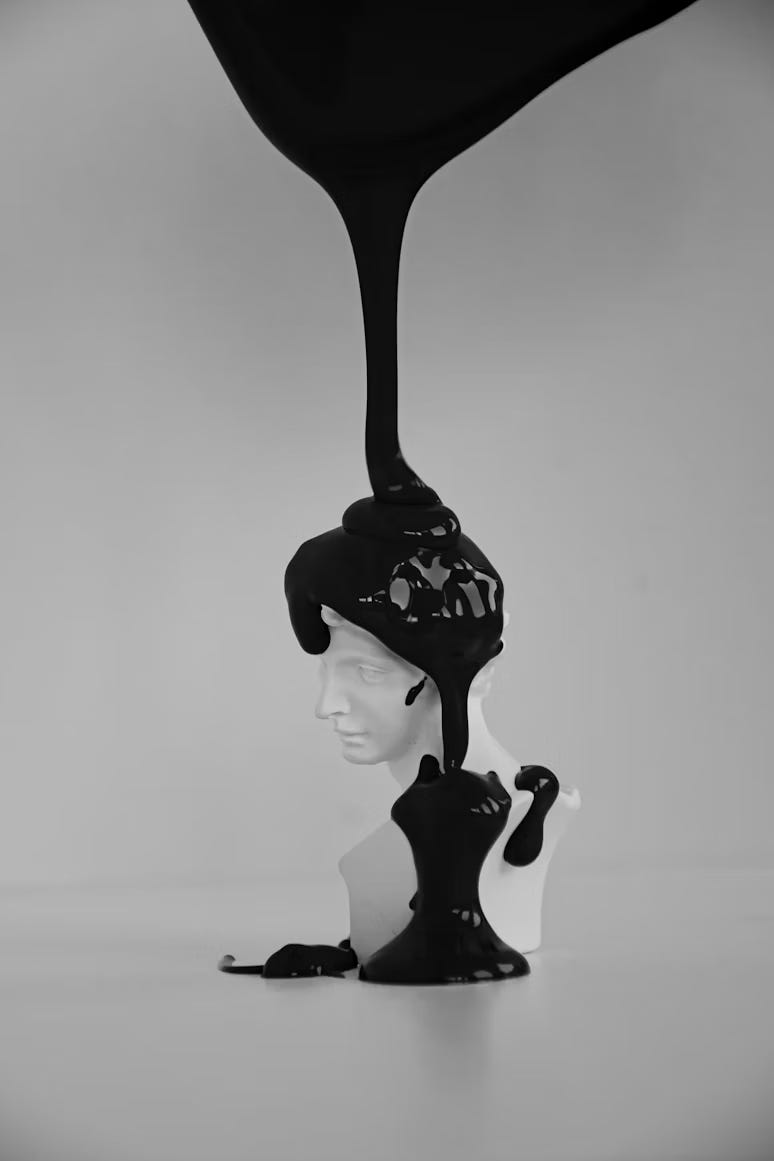
Above: Somewhere in the mess is proof of life.
You can’t spell “authentic” without “tic.”
That line has been stuck in my head for months, which is fitting, because things getting stuck in my head is sort of the whole problem. You see, I have Tourette syndrome:

I’ll spare you the full recounting here, but the short version is this: my body produces sudden jolts and shrugs and shouts, punctuation marks I never asked for. Spasms that beget stares and grunts that give rise to gawks. It is a life of controlled entropy: a careening, a hurtling, a mad dash not only to function but also to keep neurological frenzy at bay.
Somewhat relatedly, I’ve spent countless hours cataloguing a different species of tic entirely: those that punctuate AI writing.

The hallmarks of AI prose are many. They include the punchline em-dash, the three-item list, the mirrored metaphor, and the closing tautology. Though hard to define and near-impossible to pin down, with practice such tics prove immediately recognizable, the way Justice Potter Stewart described his famous threshold for obscenity: “I know it when I see it.”
In this, my world, there are two kinds of tics: one neurological, the other algorithmic. And the distance between them — between a grunt that escapes my mouth in a quiet church and the word “delve” reproduced ten million times without variation — is a vast terra incognita I’ve inhabited my entire life.
The Stream and the Boulder
Think of speech as a stream.
Water moves. It finds its way. It flows according to gravity and contour and carved stone and muddied marsh and the thousand other small contingencies of the landscape it passes through.
Now drop a boulder in it.
The water doesn’t stop. It adjusts, eddying and rippling, forming a chute where the current narrows and a lull where it pools behind the rock. A little whitewater kicks up where the force meets the obstruction. The stream becomes something worth watching precisely because it was interrupted. Without the boulder, the water is just a pipe.
My vocal tics are boulders in the stream of my speech. They are involuntary interruptions, a grunt or a bark or a word that arrives unbidden and departs with muttered apology. They break the natural course of what I’m saying and fracture the rhythm, and they make the listener recalibrate the way your eye catches on a snag in a river and follows the turbulence downstream.
AI writing is the pipe.
There are neither boulders, nor eddies, nor snags in sight. Just a smooth, frictionless channel where the water runs in a single, featureless current from beginning to end. Every paragraph hits the same beats in the same order. Every transition lands with identical weight. There is a metronomic quality that no single sentence reveals but that accumulates across the whole piece into something a trained ear can catch.
The splashes are what make sound, and sound is what makes us distinct, and what is distinct makes us human. The gentle hum of a stream and its accompanying stillness is pleasant, but not realistic to life as it’s truly lived.
As Wendell Berry sagely wrote, “The impeded stream is the one that sings.”
This great linguistic smoothing is here and it’s spreading quickly. Researchers at the Max Planck Institute found that GPT-isms like delve, boast, swift, and meticulous have exploded across podcasts and spoken conversation since ChatGPT’s release, far above their natural historical usage:
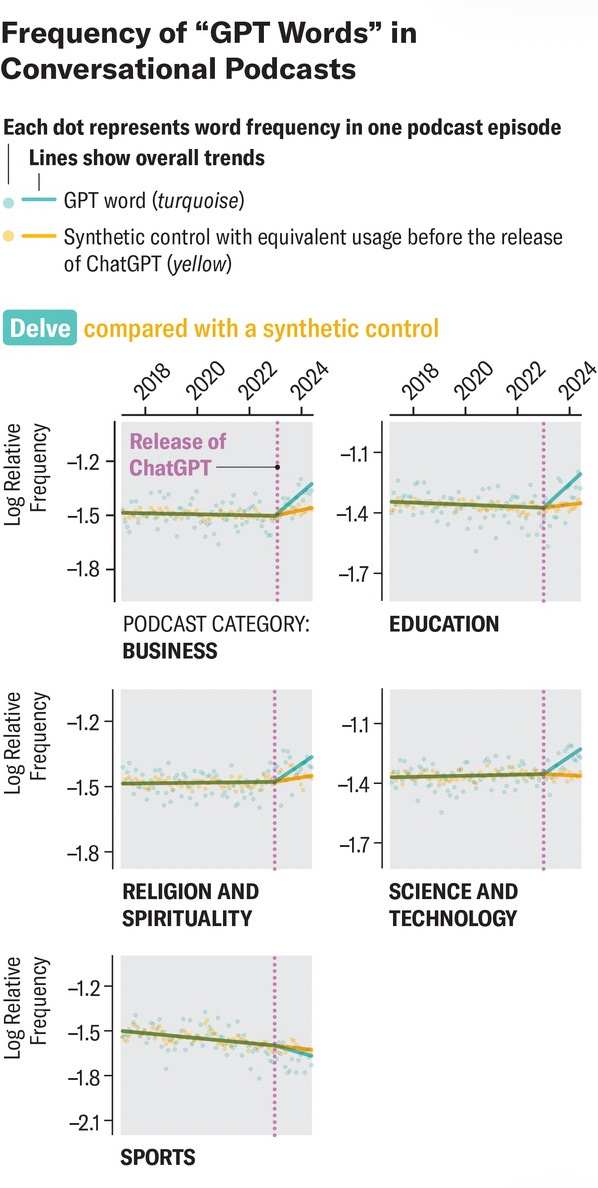
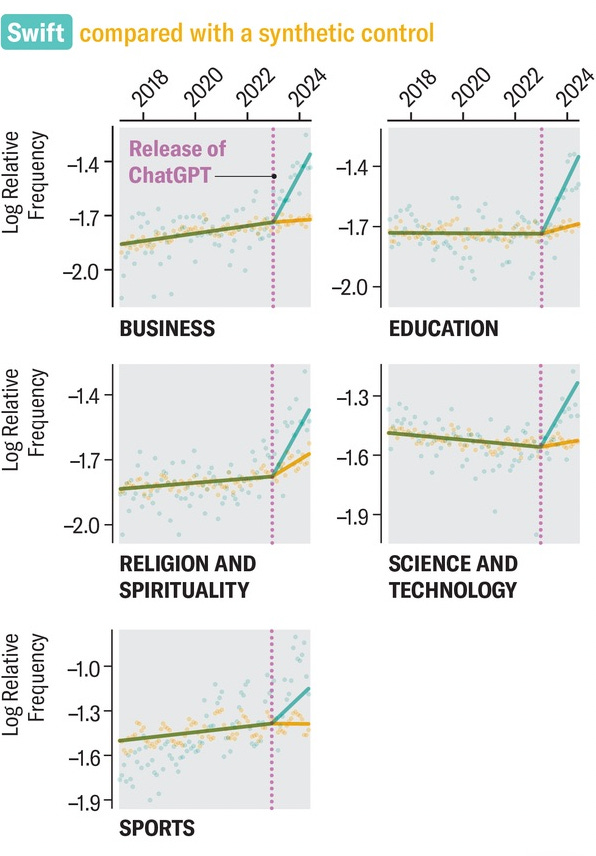
These words didn’t just appear in scripted settings; they seeped into spontaneous speech, a cultural feedback loop forming between humans and AI as we absorb its patterns until our own language becomes indistinguishable from the output.
Per The New York Times: “A.I. used to make mistakes…But today’s systems are much more fluid than their predecessors, so fluid, in fact, that finding grammatical errors or nonstandard syntax is often a hint that you’re looking at a human’s prose, not a machine’s.”
Errors are now proof of humanity. The boulder is the new watermark.
The obstruction in the stream is the only thing that tells you the stream is real. The messy bliss of splishing and splashing provides evidence of life.
The Cruel Benefit
One of the cruel benefits of Tourette syndrome, maybe the only one, is that I don’t think I can be replicated.
I want to be careful here, because I’m not claiming some grand immunity. AI is getting better at mimicking all of us, and I’d be a fool to think I’m permanently safe. (Plus, there exists a corpus of over 300 White Noise articles on which the machine can lay its metallic talons.) But there is something about the sheer chaos of the disorder that makes the machine’s job harder than usual.
Palantir CEO Alex Karp recently said that only two types of people will survive the AI era: trade workers whose jobs require a physical body, and neurodivergent people, because they think differently and solve problems in unusual ways.
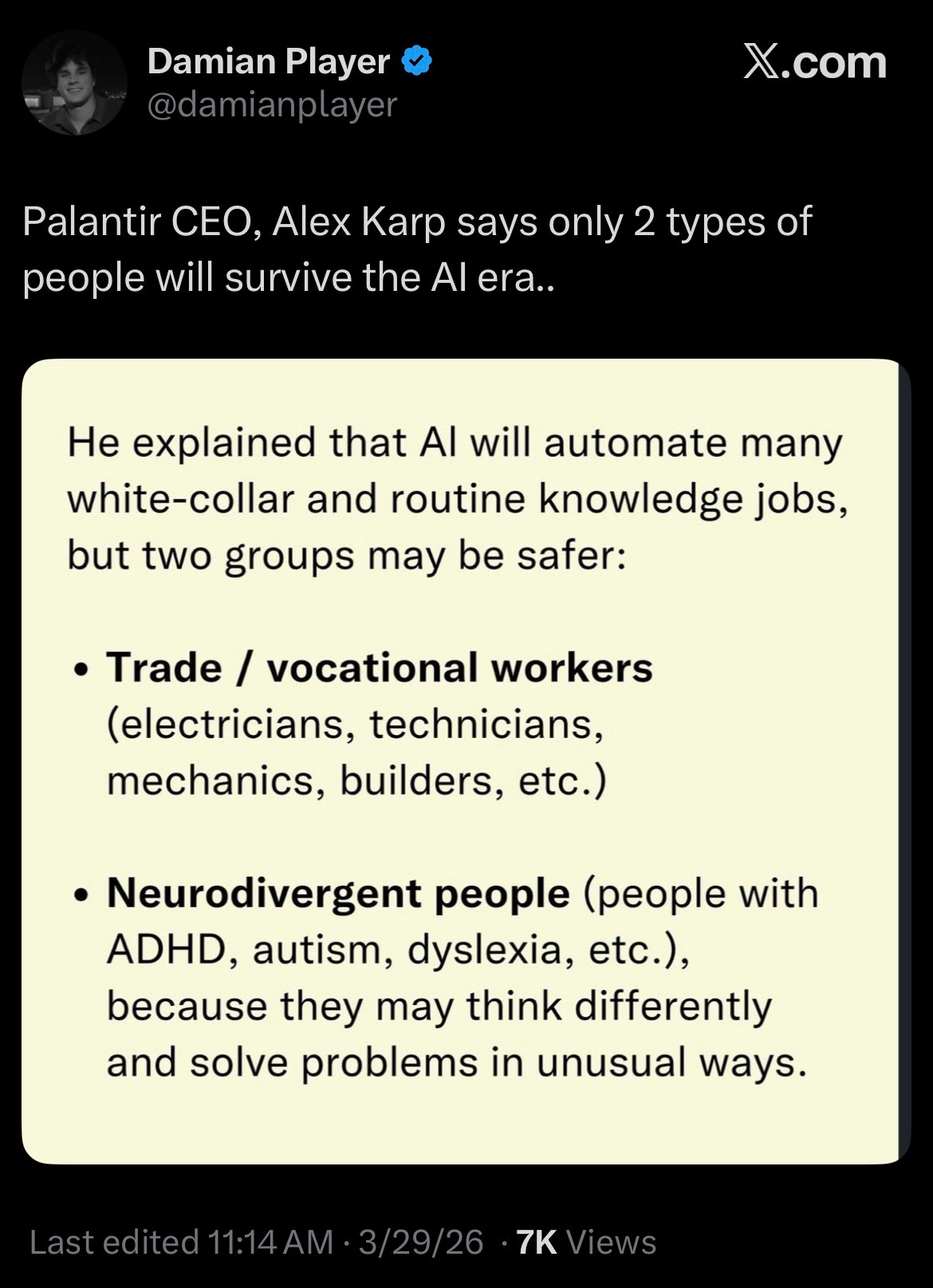
I don’t bring this up to claim I’m special or immune, but rather because my experience with Tourette, which is about as neurodivergent as it gets, has made me weird enough that I’m perhaps, just maybe, not as susceptible to the great smoothing and convergence that AI is ushering in. This, I think, is just a fact about the disorder’s maddening modus operandi.
The mind is so frenzied, so manic with its freneticism and its noise, that no two manifestations of the disorder are alike. No two of my days are alike, given the nature of the beast and its inherent unpredictability.
Tourette is a chimera: on one day, it makes you stomp, shriek, or shout about shit; on another, it simply makes you shuffle your shoes or spring spittle from your mouth. There is neither rhyme nor reason to its variety of symptoms, and no two people who suffer from it are the same.
You cannot imagine the madness in my mind, and I mean that literally, not as a boast but as a statement of fact that brings me no pleasure.
And because you cannot imagine it, neither, I suspect, can the machine.
AI works by observation, slowly and methodically ingesting your features, your patterns, your tendencies, and constructing a digital facsimile. It studies the stream until it can reproduce the current. But it can only reproduce what it can predict, and my particular chaos, at least for now, is prediction-proof. The machine cannot clone what it cannot model, and it cannot model what obeys no pattern.1
My life stands in stark contrast to the metronomic, tight, polished nature of AI writing, which follows similar patterns and takes the road always taken as opposed to that trod much less often.
AI is a failure-avoidance machine. It won’t make a typo. It won’t say something cringe. It won’t ramble or stammer or deliver a line full of ummms or uhhhs or likes or you knows. It will keep you polished, and that polish, which is quite literally a thin veneer of protection, is starting to look less like competence and more like a tell.
My tics are just the punctuation of my reality. And, for sometimes better or oftentimes worse, they cannot be faked.
I posted a note that hinted at this a while back:
A friend posted this in response:
I started adding typos to my emails on purpose. Not the kind that make me look illiterate. Just… strategic imperfections. An extra period here.. A missing capital letter there. Maybe ‘teh’ instead of ‘the’ if I’m feeling bold. Why? Because in 2026, writing too perfectly has become the tell. Perfect grammar. Flawless punctuation. That slightly-too-smooth transition between paragraphs. It all screams ‘AI wrote this and I just hit send.’ I want someone on the other end to know there’s an actual human here. That this message came from a person who cared enough to write it (albeit, imperfectly). So now I’m out here manually humanizing my own writing. Adding the equivalent of an ink smudge to prove I’m a real person.
The irony nearly killed me. I’ve been doing this involuntarily my entire life. My tics are the original ink smudge. The original proof-of-humanity. Except I never had to add them on purpose; they were added for me, by a disorder I’d give anything to be rid of, and they happen to be the one thing a machine might not be able to ever realistically replicate.
Mistakes were made and they proved it was a bag of blood and bones at the keyboard, not bits and bytes in a Cedar Rapids data center.
We humans might not capture the world perfectly. Our sight fails, our hearing goes, our muscles wither. And yet, in a world of digital perfection where every i is dotted and every t is crossed, I wonder if minor imperfections will become the signature of human writing the way a brushstroke distinguishes a painting from a print.
Its v. it’s.
The dangling modifier.
The sentence that runs on for just a bit too long because the thought outpaced the grammar.
In this brave new world, these and more evolve from flaws into an assemblage of evidence.
Freaks, Weirdos, and the War for Originality
I am not calling myself a freak. But the manifestation of my disorder is freaky, if not entirely freakish, and it makes sense to talk about things that are freaky at the opposite end of the spectrum from the polished panache of AI. As they sing in Shrek The Musical: “What makes us special makes us strong! Let your freak flag wave! Let your freak flag fly! Never take it down, never take it down. Raise it way up high!”
Alberto Romero put this better than I can in his piece Why Being Weird Is Your Superpower:
When AI closes one door, you can fixate on the door that was closed (“oh no, it can code better than me!”). Or you can realize that, by AI closing all the doors to the safer society-validated spots, you are suddenly free (“wait, who am I, actually?”). Society used to punish the non-average human as “under-average” because it decided on which trait measuring the average mattered in the first place!
Now, however, as order and predictability are outsourced to machines, you are free to explore variance again. You are free to tap unapologetically, unconditionally, into your authentic weirdness, wherever that takes you! The “average” is only defined for the traits society cares about. What do you care about? Deviance is now both self-love and rebellion.
Deviance is now both self-love and rebellion. Which is a strange and wonderful thing to say, because it means the very qualities that got you punished in school or overlooked at work are the ones the machine can neither reach nor teach.
In writing, this rebellion takes the form of striking quirks and unhinged styles. As Bree Beauregard put it:
And stand-up comedian Ken Cheng shows us the way with his own brand of touretting:
AI will never be able to write like me.
I am now inserting random sentences into every post to throw off their language learning models. Any AI emulating me will radiator freak yellow horse spout nonsense.
I believe all creative content going forward should contain elements of randomness, to prevent being replicated by AI. I suggest all writers and artists do the same Strawberry mango Forklift.
Our creativity is the one thing that separates us from the machine. To protect it, we must embrace chaos, unpredictability and utter bollocks.
We can tuna fish tango foxtrot defeat AI. All. The. Time. Piss on carpet.
This is not a strategy reserved for the creative types. We are all constantly solving problems, and those problems are often best solved by thinking laterally, by bringing whatever singular mix of character and lived experience we’ve accumulated to the table, especially the parts we were told to sand down.
Lulu Cheng Meservey put it well in Standing Out:
It’s 2026 and everything is fake. Fake content by fake influencers with fake engagement from fake followers, launching fake products with fake testimonials. A Potemkin village on a global scale, a glossy facade propped up by heaps and heaps of beige slop. Temu for content.
In this world, the real has never been more precious, refreshing, special, and rare. We need real people, building real things that actually matter, through real discipline and effort, with real outcomes in the real world.
Because polish is cheap. AI plus phone cameras means anyone can produce a flawless surface, which means a raw, imperfect aesthetic has become a credibility signal, the way a cracked spine on a used book tells you somebody actually read the damn thing.
We are entering an age where mistakes are the only proof of soul.
Mistakes Were Made
After a lifetime of involuntary interruptions and countless hours spent studying voluntary ones, I keep coming back to the same place: Absent a digital watermark that proves silicon strings were all over a bit of writing, a manually inserted one works best: the tic, the typo, the boulder in the stream that creates the eddy and proves the water is real.
My tics, both the ones I never asked for and the ones I chose (e.g. nearly every conversation I have with someone I love ends with five simple words: Love you and God bless), are proof that a specific, unrepeatable person showed up and said something only they could say.
The machine will never stammer. It will never grunt at the wrong moment or bark an obscenity in a quiet room or fat-finger a sentence because the thought arrived faster than the hand could carry it. It is incapable of producing the kind of glorious, mortifying chaos that proves a human being was here, and that incapacity, which looks like its greatest strength, is actually its greatest limitation.
Maybe the machine will learn to fake the smudge. It will learn to drop a comma and misspell the and write in all lowercase and simulate the kind of roughness that currently passes for proof-of-humanity. And when it does, we will need something deeper than strategic imperfection to distinguish ourselves. We will need the thing that can’t be performed, because it was never a performance in the first place.
I have spent my entire life involuntarily demonstrating something that other people are now trying to fake on purpose (when writing, that is). I think that when the machines learn to fake it too, what will remain is not the tic itself but the living, breathing, maddening person who ends every meaningful phone call the same way, not because it’s a brand or a strategy or a bit, but because he really means it.
Love you and God bless.
Per my about page, White Noise is a work of experimentation. I view it as a sort of thinking aloud, a stress testing of my nascent ideas. Through it, I hope to sharpen my opinions against the whetstone of other people’s feedback, commentary, and input.
If you want to discuss any of the ideas or musings mentioned above or have any books, papers, or links that you think would be interesting to share in a future edition of White Noise, please reach out to me by replying to this email or following me on X.
With sincere gratitude,
Tom
I recognize this might change. The models are improving at a rate that makes fools of anyone who draws permanent lines. But for the moment, the disorder that makes my life harder also makes me harder to copy.
So, I'm curious: Creativity has a disruptive manifestation on thoughts as well. Ideas, all of them ( wit, insight, retorts) come out of nowhere into the stream of thought. They arrive unbidden. Now, they don't land like boulders as you put it, but they do disrupt and are not consciously generated. The just are, and suddenly so.
You're demonstrably a highly creative person. How do the arrival of your own creative insights differ from the landing of your boulders? Is it similar? Gentler? A skipping stone across your mind? Something different altogether? What is your experience there?
Fwiw, I've shovelled three-hundred AI-embedded Substack posts into the maw of AI and asked it to imitate me. For the near term, the results are not worrying, although there are similarities. I'm open to being concerned eventually, then horrified, then, perversely, delighted.
Makes me wonder what a frictionless world would look like? Seamless Sameness? And what would we be without the uniqueness of our quirks, habits, self-exhibited uniqueness? We stare at the water of ocean, river or stream because of its natural complexity. We become aware of a person because of the qualities that we encounter in them that make their personhood interpretable,
as what we find when we watch them and “read” them.
If “you can’t judge a book by its cover” then we can’t judge each other when AI “covers for us” and our originality disappears, quips, quirks, misspellings and all.
AI may perform perfectly for us, but does AI have “personality” that exhibits a “self”?
Your authenticity is noted in your unabashedly sharing the qualities that make you “you”. Long live the realism that connects us in our self owned imperfections.