

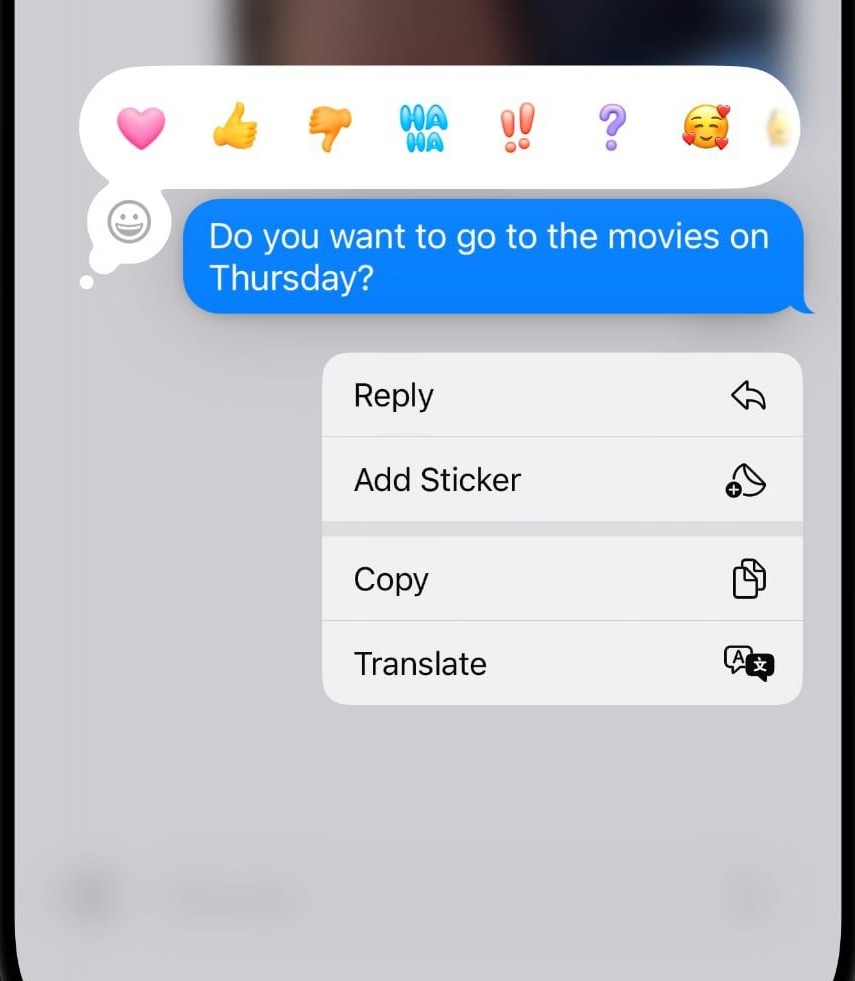
Above: Convenience in place of communication.
I despise the tapback.
You’ve seen it before, even if that word does not exist in your vernacular.
You send a friend something you spent twenty minutes laboring over.1
You hit send, then set your phone down on the counter.
It vibrates.
You pick it up and there it is: a tiny heart appended to your message.
In the end, that little tapback is all your friend gives you back in response to your labor of love.
Such is the tragedy of modern communication.
Apple added Tapback to iMessage in 2016 with the introduction of iOS 10.
The menu first had six options: a heart, a thumbs up, a thumbs down, “ha ha,” a double exclamation point, and a question mark. Then iOS 18 opened the floodgates and allowed you to react with any emoji on the keyboard. Now you can reply to a eulogy with a taco emoji. The pitch, per usual, was efficiency: why type “lol” when you could just press it?
What a Tapback Actually Says
There is always meaning behind what we do and how we do it. The tapback does not escape this incontrovertible fact. By replying with a simple heart, my friend attempts to say that they loved what I sent. To me, the recipient, it’s their way of saying they saw my message and decided not to reply.
Sometimes silence is much kinder than people think, for it leaves room for interpretation — maybe he was on the subway; maybe her phone died while out at the bar; maybe they wanted to reply, but just couldn’t find the right sequence of words. You can allow yourself to dwell in those scenarios for a few days.
The tapback murders this maybe. It makes abundantly clear that your message was read and then filed away. In a way, it is the read receipt’s meaner cousin. Read receipts show someone opened your message. A simple tapback makes it clear they opened it and then set it aside.
Shadows in the Cave
Since I’m very much a product of my Jesuit education, I often end up referencing Plato.
The allegory of the cave states that there are humans trapped in a cave from birth. They can only see objects’ shadows on a wall projected by a fire. These humans believe these shadows are life, itself. In Book X of the Republic, Socrates takes aim at the concept of painting. If a woodworker creates a bed, that bed is no more than a representation of an idealized bed. Painting that bed would mean making a copy of a copy of the ideal. Socrates goes on to state that paint is then three degrees removed from reality.
A text message is well at home in the cave. It is conversation sans essential information such as facial expressions and tone of voice. You can neither hear a pause nor see someone’s eyes go soft via text. In this way, the tapback is just a copy of that copy. Though in the shape of a reply, it carries nothing of substance. All of us remain in that cave, gazing at a small heart displayed on a screen.
The Cheapest Signal in the World
Economists have long posited that a signal only works if it comes at some kind of cost. Indeed, Michael Spence became a Nobel Laureate partly for showing that a college degree tells employers something because it’s hard to get.
Animals have learned this as well. After all, peacocks grow huge, impractical tails in order to impress females. This concept, called the Handicap Principle, was first introduced by evolutionary biologist Amotz Zahavi.
A tapback costs nothing; just a long press and quick tap of the thumb. It’s among the least costly signals a person can send to someone else. Whether someone adores you or barely knows your name, they can still send the same tapback. A typed reply costs mere minutes of that thing which we all lack: time. When I spend it on you, you know you matter, because I could have spent it on anything else.
Harvard linguist George Zipf wrote an entire book on this concept back in 1949. According to Zipf’s law, people will invariably choose the route that requires the least effort in not only action, but also language. Silicon Valley took this as marching orders and, because of it, we got one-click checkout from Amazon and one-tap affection from Apple.
Where the Tapback Belongs
I’m no Luddite; I wouldn’t go so far as to say the tapback should never be used. I both own an iPhone and use the tapback almost daily. It has its uses in certain scenarios.
“Landed safely” and “En route” deserve a thumbs up or heart and nothing more.
An inside joke or clever meme require a “Haha.”
Group chats also earn a pass. If fifteen people answered every message in full sentences, the thread would become unreadable.
Logistics and banality only ever need an acknowledgment in the form of a tapback.
The trouble is that the tapback doesn’t stay in its lane. It leaks into those messages that truly matter. A friend tells you his cancer is back or a crush sends a love letter she rewrote umpteen times before working up the nerve to finally hit send. A heart in those moments is no more than an insult wearing kindness as a mask.2
Convenience is Eating Communication
There are a myriad of things we should not be doing over text. After all, you cannot kiss someone via keystrokes. Friends should see each other in person or at the very least talk on the phone. Texting represents the grout between the bricks of in-person friendship. It is a shoddy, though serviceable, middle ground to communicate when you can’t meet up. Tapping back just pulls us further away from that.
Increasingly, convenience is eating communication alive. In 2023, the Surgeon General deemed loneliness an epidemic. The tapback didn’t cause this, but if we’re not careful, it may well finish us. We built a button that lets us acknowledge people without engaging them. Most days we press it without giving it a thought; that is precisely the problem.
My rule now is simple. If a friend spent words on me, I send words back.3
If I can’t do it today, I write tomorrow.
The heart can wait for the next “landed safely.”4
Per my about page, White Noise is a work of experimentation. I view it as a sort of thinking aloud, a stress testing of my nascent ideas. Through it, I hope to sharpen my opinions against the whetstone of other people’s feedback, commentary, and input.
If you want to discuss any of the ideas or musings mentioned above or have any books, papers, or links that you think would be interesting to share in a future edition of White Noise, please reach out to me by replying to this email or following me on X.
With sincere gratitude,
Tom
Ideally, these sorts of messages would be delivered in person or on the phone, but we live in a world that is far from ideal.
There are some exceptions. A friend who’s struggling might not be able to manage more than a heart in response to your text. In those moments, a simple heart reaction from them is all we can really hope for. But I don’t think that scenario applies to most of us when we’re tapping back.
And they should be my words, typed by my own thumbs because handtyped is the new handwritten. A generation ago the thing you saved was the letter in your grandmother’s cursive. Now a machine will draft either birthday text or condolence note in four short seconds, so the handtyped reply is what proves personhood and enough care to expend sweat and tears over you.
Because fate loves irony, I know that I will send this post out and my phone will be flooded up with hearts. Such is life. I accept said barrage as my sacrifice for you, dear reader. That said, if you have any thoughts, I’d love to hear them in words, not emoji.
❤️
Guilty Tapback user here. I appreciate you pointing out times when it’s acceptable, but I expect your piece will make me more thoughtful about my tapping tendencies.