

Fairy tales do not tell children the dragons exist. Children already know that dragons exist. Fairy tales tell children the dragons can be killed.
―G.K. Chesterton
The cave you fear to enter holds the treasure you seek.
—Joseph Campbell
You waste years by not being able to waste hours.
—Amos Tversky
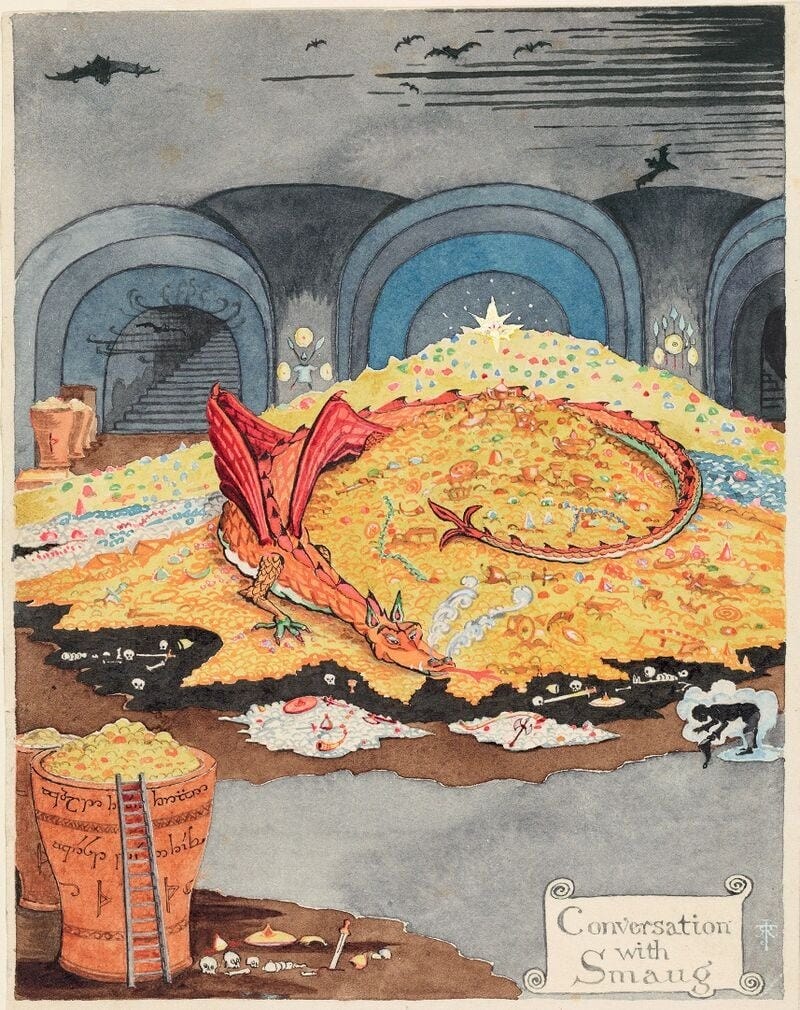
Above: The aforementioned cave.
We live in an age of infinite paths.
Every morning, the world offers us a branching tree of options: messages, tabs, tasks, tools, temptations. Our mistake is thinking we can walk all of them.
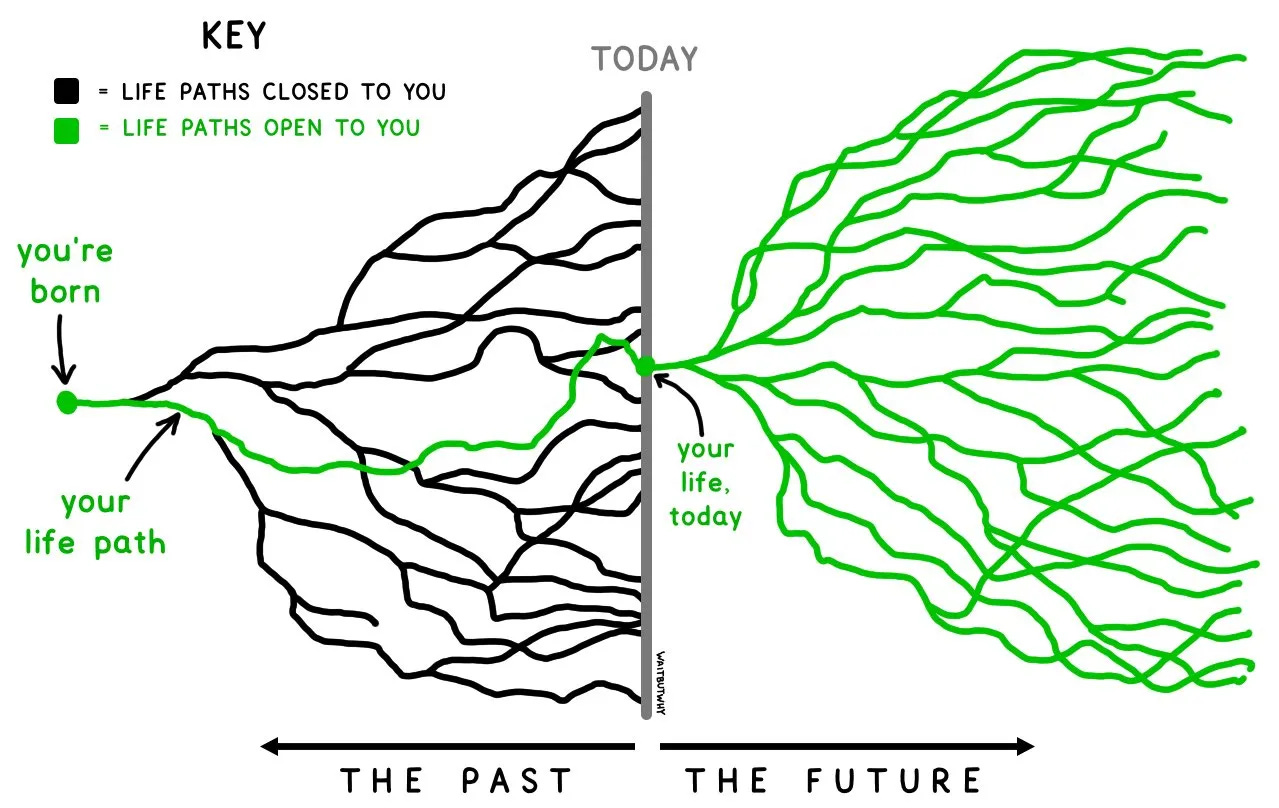
We can’t.
The pings we carry are too damn heavy:
The Pings We Carry

It was very sad, he thought. The things men carried inside. The things men did or felt they had to do. —Tim O’Brien
As most of our waking hours are spent working, we ought to examine not only our projects but also our motivations.1
From where I sit, there are two essential kinds of work: Dragon Work and Hydra Work.
The former can be slain, but the latter only multiplies.
They are close cousins and often indistinguishable; therein lies the difficulty for the modern worker.
The exhaustion from attacking these foul beasts is the same, but the outcomes vary wildly over a week, a month, a career.
Hydra Work
Hydra work is inherently reactive.
You cut off one head and three more appear.
Clear an inbox, and Slack lights up.
Close a ticket, and two more open.
Answer the email, schedule the meeting, respond to the DM, nudge the thread.
The Hydra thrives on attention, feeds on urgency, and rewards speed, not depth.
It comes with a little chemical bribe: the quick squirt of dopamine you get from “handling” something. You feel busy, needed, and productive, but you never feel done.
In a GIF:
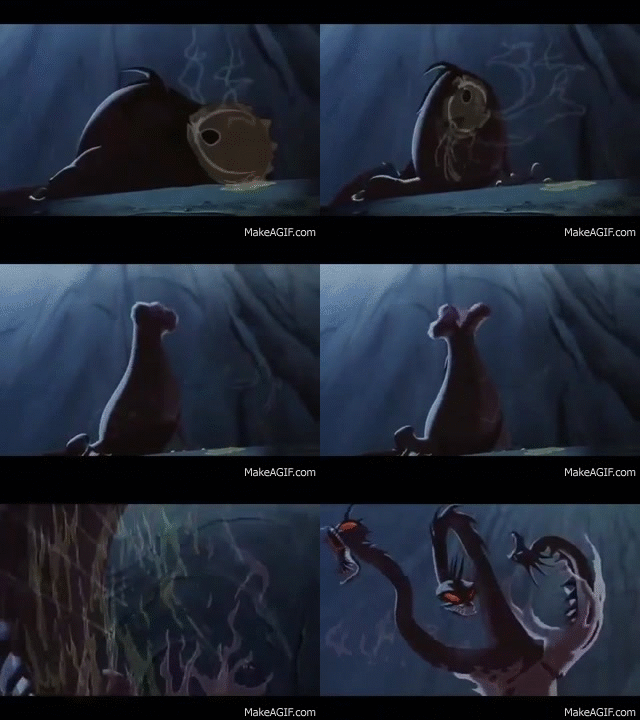
Hydra work is how you lose your life to a million responsible decisions. It is death by a thousand “This will just take two minutes.”
Dragon Work
Dragon work is different.
Dragon work is deep, slow, and singular.
It’s big, scary, and sometimes breathes fire.
It’s not something you “just do.” It doesn’t “take just a sec.” You have to muster up the courage and be in the right frame of mind to attack it.
It demands a great deal of time, undivided attention, and careful strategy.
You don’t swat at it. You face it.
Dragon work consists of writing a real essay. Designing a durable system. Articulating a point of view that costs you something. Building a process that eliminates ten future problems instead of reacting to one present one.
Dragon work has a before and an after.
It breaks out of the interminable middle where the hydra makes its home.
Hydra work just makes more of the same mess.
Dragons are scary, but at least they are finite.
A dragon can be slain.
A hydra only multiplies.2
A Simple Test
Hydra work is work that disappears when completed.
Dragon work is work that remains.
Hydra work evaporates.
Dragon work compounds.
Hydra work makes you feel “caught up.”
Dragon work makes you feel built up.
Hydra work asks, “What needs responding to?”
Dragon work asks, “What needs making?”
Hydra work keeps you alive. Dragon work gives you a life.
Most people fail not because they don’t work hard, but because they’re attacking the wrong lizard.
And even when they pick the right one, they show up with the wrong weapon.
Finding Your Dragon
But how do you know which dragon is yours?
You follow your attention.
In the Renaissance and early modern period, nobles built cabinets of curiosities—Wunderkammer, “wonder-rooms”—private museums of shells, fossils, artifacts, oddities. A physical proof-of-taste. A curated map of what the collector found worth keeping.
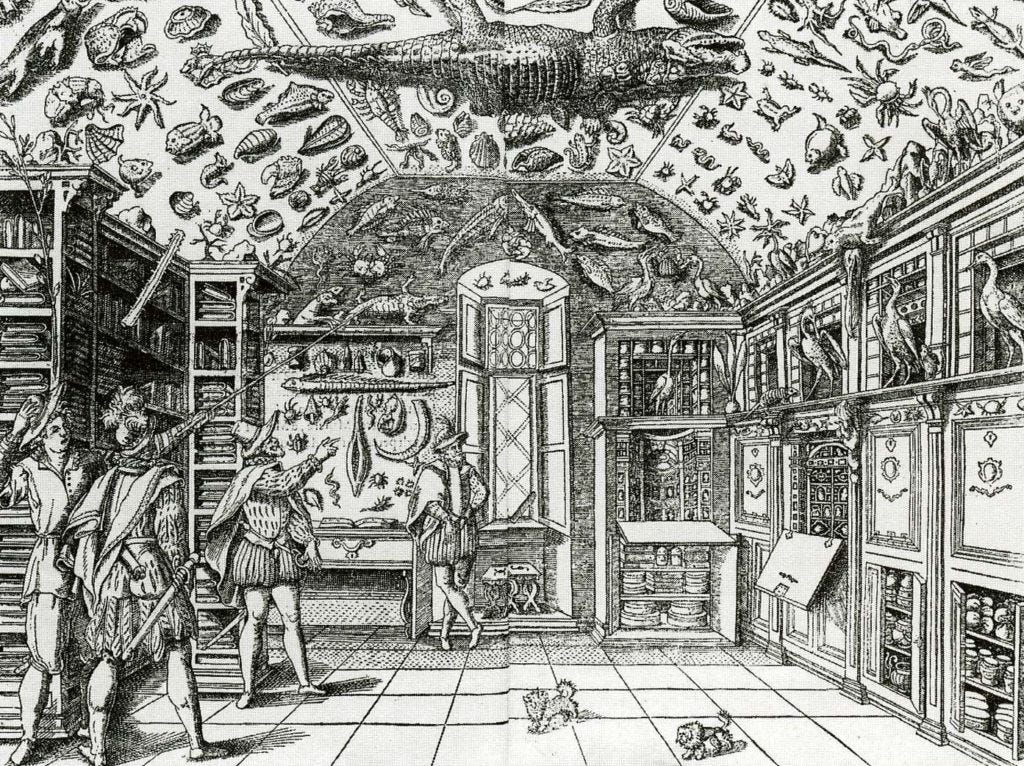
The internet gives us infinite curiosities but no cabinet. Everything streams past. Nothing accrues. We know we’ve seen something brilliant, but we can’t find it when we need it.
Sublime is my version of the wonder-room. Instead of hoarding oddities to impress visitors, I quietly collect the ideas that catch me: passages, screenshots, quotes, fragments, little mental splinters I can’t stop touching. Over time, my library has become a trail of breadcrumbs my attention has left behind.
And attention, inconveniently, is honest.
Here’s what that looks like in practice: while writing this essay, I searched my Sublime library for everything I’d saved about productivity, work, and meaning. Cards I’d forgotten I kept—a Campbell quote, a half-remembered thought about Protestant work ethic, a picture of Smaug from The Hobbit—surfaced.
The dragon I’d been circling for weeks (i.e. this very piece) suddenly, and quite literally, had a shape.
Better yet, I can chat with my collection. The difference between “help me research deep work” and “help me research deep work using these twelve ideas I’ve been collecting for two years” is the difference between a commodity and a point of view, between slop and substance.
It also helps those breadcrumbs cluster. You save a card, and you can discover related cards—other people’s adjacent notes, essays, and influences—like walking into a room where the walls keep revealing secret doors.
Or in Sublime’s own words, it is…

This matters because Dragon work begins the same way treasure hunts do: with curiosity.
If you don’t know which dragon you’re meant to fight, look for the themes you keep orbiting when no one is watching. The obsessions that recur. The questions that won’t die. The paragraphs you re-read. The problems you keep trying to solve from different angles. The sentences that stir you from your slumber and demand you write them down.
That’s usually the dragon.
And once you can name the dragon, a tool like Sublime becomes more than a wonder-room—it becomes an armory. A place where you store the weapons you’ll need: frameworks, examples, techniques, sentences that sharpen your thinking, tools that turn fear into forward motion.
Fighting the wrong dragon is a tragedy, but fighting the right dragon with the wrong tools is torture.
If you want to avoid such a travesty, try Sublime: Readers get 20% off with code WHITENOISE.
Effort + Direction
Effort without direction is reckless.
Direction without effort is feckless.
We need both sweat and a compass. The discipline of showing up and the wisdom of choosing the right battlefield.
Because the only way out is through and the only way through is to pick a path and stick to it.
So pick your dragon.
Keep the scaly beast front and center.
And slowly, surely, unglamorously hack away.
Hydras will always hiss for attention.
But dragons are where true treasure lives.
Which brings us to you, dear reader.
What work are you avoiding by reading these words? Dragon work or Hydra work?
If it’s the former, get back to it.
If it’s the latter, consider changing course.
Either way: sharpen your sword and take up your shield.
Once more unto the breach, dear friends.
Per my about page, White Noise is a work of experimentation. I view it as a sort of thinking aloud, a stress testing of my nascent ideas. Through it, I hope to sharpen my opinions against the whetstone of other people’s feedback, commentary, and input.
If you want to discuss any of the ideas or musings mentioned above or have any books, papers, or links that you think would be interesting to share in a future edition of White Noise, please reach out to me by replying to this email or following me on X.
With sincere gratitude,
Tom
Sidebar: AI will sever the deepest identity loop in the west, that who you are = what you do for money. The Protestant Work Ethic was a load-bearing wall for the Western psyche. We are dismantling it without a blueprint for what comes next. Like it or not, passion is about to be just as important as profit.
We’re filling our days with Hydra work right as machines are being built to handle it better than we ever could. Triaging messages, drafting replies, scheduling calls, following up on loose ends—most Hydra work is legible, and anything legible becomes automatable.
Interesting distinction. What popped up in my mind while reading was: we might be trying to accomplish dragon work with hydra work. That is, using AI to tackle a dragon work. Either by breaking it down or even outsourcing it completely. Just to feel more productive, efficient. And empty. Like writing a substack post totally written by AI.
You framed this very well Tom, great piece.