

Home is where one starts from.
— T. S. Eliot
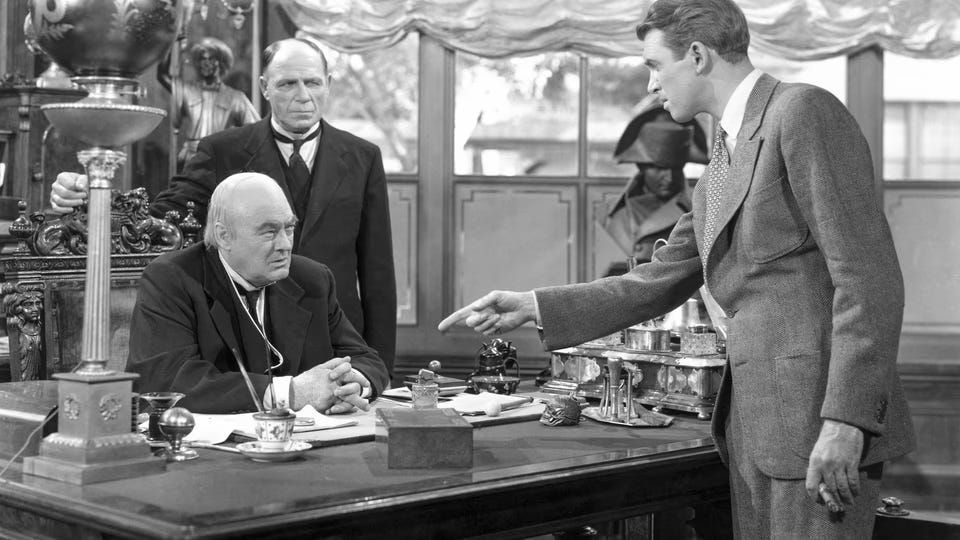
We were doing our annual family Christmas ritual: laying about together, It’s a Wonderful Life on the TV, the room half-lit by the tree, everyone mouthing along in old-timey accents, when one scene landed differently for me: the Building & Loan showdown between George Bailey and Mr. Potter.
It lodged in my head and refused to move:
We usually watch It’s a Wonderful Life because it serves as a Christmas fable about kindness, however, if you watch the boardroom scene in 2026, the genre shifts. Instead of a period piece, it morphs into a documentary about the modern housing market.
In the scene (watch it if you have three minutes), George Bailey stands across from Mr. Potter, defending the decision to underwrite a $5,000 house for a taxi driver.
Potter sneers like the idea of a working man owning anything is a joke:
“What does that get us? A discontented, lazy rabble instead of a thrifty working class and all because a few starry-eyed dreamers like Peter Bailey stir them up and fill their head with a lot of impossible ideas.”
The lesson in 2026 is that the starry-eyed dreamers are still out there. But they are a “discontented rabble” for reasons Potter would never understand: despite being thrifty, despite working like dogs, they still can’t afford a house.
When you zoom out and consider this carefully, you realize that this is not a conflict over dollars and cents, but a debate about time.
Delay and the $5,000 Question
Potter represents the view that housing is a reward for discipline. His argument is seductive because it sounds like prudence: Wait. Work. Save. Earn the right.
George Bailey represents the counter-argument: Housing is the essential infrastructure of adulthood. If you delay it, you delay the citizen—and by doing so, you hurt both the community and the country.
When Potter argues that the working class should wait until they have saved the money, George responds with lines that embarrass the modern economy. He refuses to treat human life as a spreadsheet problem:
“Wait! Wait for what? Until their children grow up and leave them? Until they’re so old and broken down that… Do you know how long it takes a working man to save $5,000?”
In Bedford Falls, $5,000 is the mountain.
In 2026, $5,000 is what a lot of people pay to borrow a home for a month.
Today, the working man isn’t saving for a $5,000 house. He is saving for a down payment that moves like a mirage, always one raise away, always one interest-rate cut away, always one “just a few more years” away. Therein lies society’s bifurcated bargains:
The Boomer Bargain: Work hard. Buy a home. Let time make you rich.
The Youth Bargain: Work hard. Rent. Watch time make someone else rich.
The cruelty is that the youth bargain still demands the moral posture of the boomer bargain—be disciplined, be responsible, be patient—while stripping out the reward that made the discipline coherent in the first place.
Potter is as shrewd as he is plausible. Notice that he doesn’t say, “No, the taxi driver doesn’t deserve dignity.”
He says, “Not yet.”
This is how a society can be deeply unjust while feeling superficially reasonable.
If a “decent home” requires a decade of delay, we’re stillbirthing family formation and kneecapping our very future.
The Architecture of Scarcity
The gap between the boomer bargain and the youth bargain is where the social contract broke.
Perhaps the most emblematic milestone of the American Dream, housing tells you when adulthood begins, when marriage is “responsible,” when children are “affordable,” when you’re allowed to stop living like a transient in the city to which you supposedly belong.
As I noted in The Boomer Republic, housing also tells the story of generational stratification:
Zooming out, according to Fannie Mae, home prices need to fall 40% or incomes need to rise 60% just to return the housing market to 2019 levels.
Worse, this is not just limited to the United States; it is a global problem.
Per Asia Inside: Why is Taiwan the Poorest Among Developed Countries? (emphasis mine):
Until recently, people could endure thanks to relatively low living costs. But after COVID-19, things changed: not only was home ownership already out of reach, but inflation has driven everyday expenses sharply higher.
Nothing illustrates the poverty of Taiwan’s youth more clearly than the phenomenon of the taofang. A taofang is essentially an apartment divided into multiple tiny units, often with illegal extensions that stick out like container boxes to maximize floor space. These cramped rooms, barely large enough to lie down in, rent for $290 to $360 a month in Taipei.
Since a third of their monthly salary has to go toward renting such cramped rooms, there is little capacity left to save for the future. Even if young people manage to find jobs despite a real unemployment rate in the mid-teens, their wages make it nearly impossible to ever buy a home.
Not long ago, one statistic showed that in order to afford a house in Taipei, a young worker would have to save their entire salary—without spending a single cent on food or living expenses—for 28 years.
The past is subsidized and squats; the future is priced out and prays to find something affordable.
Cattle v. Imago Dei
The crisis we face is a conflict of definitions.
To Potter, a house is an asset: a tool to leverage and a gate to keep the “rabble” out.
To George, a house is a start. It is where you shelter your baby, rest up for your job, put food on your table, welcome your neighbor, embody civic courage. It is the basic unit of belonging.
George’s rebuke to Potter is both the moral center of the film and of the housing crisis:
“Just remember this, Mr. Potter, that this rabble you’re talking about, they do most of the working and paying and living and dying in this community. Well, is it too much to have them work and pay and live and die in a couple of decent rooms and a bath? Anyway, my father didn’t think so. People were human beings to him, but to you, a warped, frustrated old man, they’re cattle.”
Once a society starts treating people as cattle, everything becomes justifiable: the delays, the indignities, the endless hoops, the roommate purgatory into your young old age, the postponement of children until the almighty spreadsheet turns green.
But human beings are neither cattle, nor assets, nor liabilities.
They are made in Imago Dei, the image and likeness of God.
And the entire point of a political economy is to make it possible for ordinary people to take on ordinary responsibilities—work, family, community—without needing a permission slip from the asset-owning class.
The Verdict
We have built a Potter economy.
We have prioritized the protection of asset values over the creation of new neighbors.
We reward incumbency and punish entry.
We tell the young to work themselves to the bone until they qualify. To live with roommates until their thirties. To delay children until the chart looks safe.
George Bailey fought to stop Bedford Falls from becoming a machine that eats its own future.
The movie leaves us with a litmus test for our own time: When the young ask for “a couple of decent rooms and a bath,” do we hear citizens speaking or cattle lowing?
If our answer is ‘wait,’ Potter won.
Per my about page, White Noise is a work of experimentation. I view it as a sort of thinking aloud, a stress testing of my nascent ideas. Through it, I hope to sharpen my opinions against the whetstone of other people’s feedback, commentary, and input.
If you want to discuss any of the ideas or musings mentioned above or have any books, papers, or links that you think would be interesting to share in a future edition of White Noise, please reach out to me by replying to this email or following me on X.
With sincere gratitude,
Tom
I am convinced that the housing problem has very little to do with the structure of our economy, but rather of government incompetence. Let’s start with rents: Joe Biden ushered 20 million illegals into our nation. These same have taken over many of the jobs that native born Americans used to do. How many housing units must be built to house 20 million newcomers?
So rents skyrocket. Mr. Potter would be proud.
Try to build a house out here in California. It’s just a pipe dream. Today I heard that one year after the Los Angeles fires only 10 houses have been rebuilt, mostly in Altadena. Thousands of houses burned to the ground and only 10 rebuilt? The government gets in the way and refuses to allow the market to correct the problem. Meanwhile, the California Coastal Commission impossibilitates new construction anywhere near the coast. Small wonder a shack in Monterey is pushing $2 million.
The fundamental problem of Housing can be found in supply and demand. If Jerome Powell at the Fed could suppress his TDS long enough to lower interest rates, think of what a boon that could be to the economy and Housing starts.
I’m really glad you addressed this topic Tom. One person who has taken an interesting approach to creating truly affordable housing is Elon Musk. He has come up with cleverly designed small houses that can be purchased for a song. Maybe not $5000, but not far north of that.
Finally, several states are looking into eliminating property tax. As a philosophical matter, property tax is just a way for the government to own all the property in the country, keeping us all as tenants to the State. I would love to see all property taxes abolished so that Mankind could take the helm of true home ownership.
I've seen the movie a hundred times, but his speech sure does sum things up today. So many young folks are "one raise" away from a dream that isn't happening. I suppose we'll just have to build families in our parents' houses until things change, if ever. It is a ridiculous situation. Great post, Tom.