

The difference between the almost right word and the right word is really a large matter—’tis the difference between the lightning-bug and the lightning.
—Mark Twain
It is precision that gives writing power.
—Gustave Flaubert
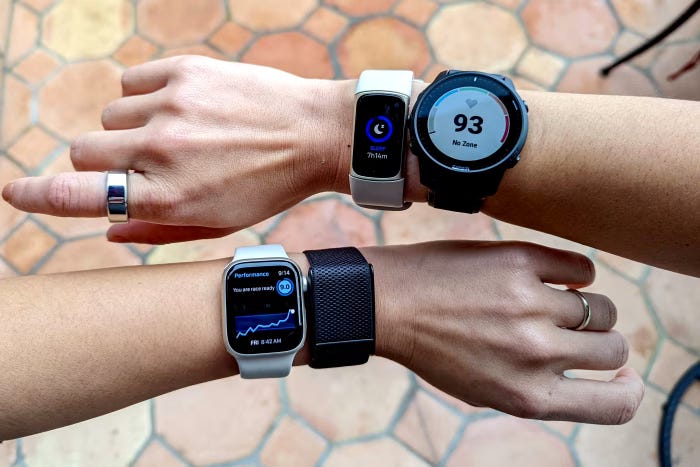
Above: Two wrists, five trackers, a thousand metrics, and zero words.
We measure everything now.
We wake up with our Ouras on our fingers and work out with our Whoops on our wrists.
Sleep scores, HRV, strain, recovery, readiness, oh my! The deluge never ceases; we are positively drowning in data.
We know our resting heart rate to the beat and our REM cycles to the minute and treat a 2% dip in recovery like a mortal wound.
Then we walk into a meeting and use the word “strategy” or “ leverage” or “synergy” to mean a whole bunch of nothing.

Such is the asymmetry of modern life. We are fanatical about quantitative precision and careless about qualitative precision.
We track our glucose but not our grammar.
We audit the spreadsheet but never the sentence.
At first glance, it sure seems oxymoronic.
“Precision belongs to numbers,” you might protest.
“Language is soft,” you might languidly murmur.
But the opposite is true. Precision in numbers is code for machines. Precision in words is code for humans.
Software runs on the former. Companies, marriages, friendships, and nations run on the latter.
Which, dear reader, is more important?
Elon Musk—planet earth’s first trillionaire, mind you, so he must know a thing or two!—says a company’s success is the vector sum of its people’s talent. But vectors have direction, not just magnitude.
Strong people pointed at different things cancel one another out. Direction is set by words. Mission, vision, values. The email. The memo. The offhand comment in the hallway that someone took literally.
Misaligned numbers are caught in the careful audit. Misaligned words loosely compound for years.
The machines have mastered quantitative precision. They calculate flawlessly and reconcile your books and optimize your funnel and A/B test your subject lines and more until kingdom come.
The measurable work is collapsing in cost towards zero.
What remains at the end of the day is that which cannot be measured: the qualitative.
Whether your team means the same thing by “quality.”
Whether your customer hears what you think you said.
Whether your beloved believes it when you utter “I love you.”
Whether the word you chose carries the weight you intended.
That work was always the hard part. We just hid from it behind fluff.
So, instead, we wear computers on our wrists that quantify our bodies down to the millisecond, while the words that govern our work, our relationships, and our inner lives go undefined, unexamined, unweighed.
In short, we optimize the heart rate and neglect the very thing that does the beating.
When we outsource our thinking to the machine and cede our words to an alien, artificial intelligence, we amputate something of the soul. Language was never merely a tool. It is a gift from God that lets us not only communicate, but also commune. To give it away is to surrender the holiest thing we were ever handed.
After all, the Gospel of John doesn’t open with “In the beginning was the data,” but “In the beginning was the Word, and the Word was with God, and the Word was God.”
The Logos is literal life incarnate.
The ancients understood that reality itself is undergirded by language, that to name a thing precisely is to know it, and that sloppy speech makes a sloppy soul.
Sure, your watch will tell you that you slept poorly, but it will never tell you that you spoke poorly.
Check your words like you check your recovery score. Define your terms. Say what you mean and mean what you say.
And so, I won’t waste any more words. For the case for words was made better by a teacher surrounded by students in a tinseltown studio. I leave you in his steady, ready hands:
Per my about page, White Noise is a work of experimentation. I view it as a sort of thinking aloud, a stress testing of my nascent ideas. Through it, I hope to sharpen my opinions against the whetstone of other people’s feedback, commentary, and input.
If you want to discuss any of the ideas or musings mentioned above or have any books, papers, or links that you think would be interesting to share in a future edition of White Noise, please reach out to me by replying to this email or following me on X.
With sincere gratitude,
Tom
Thanks for sharing Tom! Have found your blog recently and read through so many of your works, I love the way you write and express your thoughts. It's been helping me a lot in my own writing journey but I especially resonate with this one :)
Yes yes and yes.