

How dull it is to pause, to make an end,
To rust unburnish’d, not to shine in use!
As tho’ to breathe were life!
—Alfred, Lord Tennyson

Above: From the dustbin of history to the prefrontal cortex.
Though Jean-Baptiste Lamarck was wrong about giraffes, he sure was right about us.
A French naturalist, Lamarck argued that traits grow stronger through use and weaker through disuse. Stretch for leaves your whole life and your neck lengthens; stop reaching and it shrinks. The biologists laughed him out of the room. Darwin got the laurels and he got the jeers.
But here we are, two centuries later, watching Lamarck’s thesis play out in real time. Not in our bodies, but in our minds.
Open X and you’ll see it baked into the interface: a button that turns confusion (read as: sloth) into a product. Every single post now comes equipped with a Grok button.
See a tweet you don’t understand? Don’t sit with it. Don’t do the quiet work of reconstructing context, following the thread, or piecing together references.
No, instead just press the button and—voilà!—comprehension as a service.

“Wildly cool technology.” Yeah, that’s one way to look at it.
But scroll for two minutes and you’ll notice how people are actually using it. Not for deep research or hard problems, but basic reading, simple interpretation, and critical thinking. The kind of mental work that used to happen automatically—silently—between your eyes and your brain.


It looks like information access at the speed of light. It’s actually intellectual atrophy, one query at a time.

The meme is harsh. It’s also a roadmap.
The muscle that does the work of comprehension, of context, of reading between the lines, never fires. And a muscle that never fires only withers and wastes away.
This is a willful lobotomy. A voluntary, cheerful severance of the very capacity that makes us literate adults. A preference that is fast becoming the new default.
We are choosing convenience over cognition and calling it progress.

All while Lamarck leers at us, smirking from the grave.
Behold the miracle of modern work:
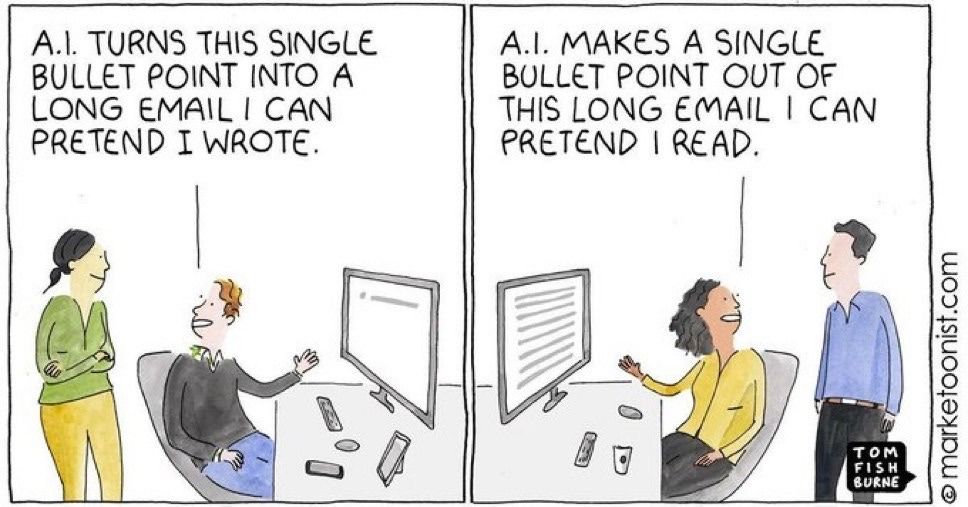
The above exchange could have—no, should have—been a sentence between two humans. Instead, it passed through two machines and neither person touched the thought.
AI takes conversational color, content, and context and strips it bare. Thoughts turn into puree and sentences into soup. Anything with texture—argument, nuance, tone, intent—gets blended down into a gruel-like gist. Color becomes paste. Context becomes sludge. The output swells. The meaning thins.
The elegance of “In the beginning was the Word, and the Word was with God, and the Word was God.” turns into the brutalism of “From the start, God = the Word.”
Now follow the thread to its logical end:

AI generates the assignment. AI does the assignment. AI grades the assignment. The child is decorative middleware. The student isn’t being educated, but routed through. No child left behind indeed.
This is what a society looks like when nobody does their homework. We will all suffer for it.
And “suffering for it” is not a metaphor:


We went from not reading terms and conditions, to not reading permission prompts, to not reading what’s running on our own machines.
We trained ourselves for years to press “accept” without understanding. Now we’re training ourselves to press “explain” without thinking.
We’ve treated this as a harmless habit for years. It isn’t. Caveat emptor is a slogan, not a security measure. The atrophy isn’t just intellectual. It’s practical. It has a cost measured in stolen credentials, drained wallets, and compromised lives.
When you train yourself to press the button instead of doing the work, you eventually press the wrong button.

There is a big difference between reading War and Peace and skimming its Wikipedia page. Between writing a condolence note and prompting one. Between showing up and subcontracting your presence.
The difference is you. Your diligence. Your effort. Your willingness to struggle with the thing until you understand it, or until it understands you and so emerges.
Founder Will Manidis put it well:
The middle is still where the complications live, where the position is ambiguous and the thing no one modeled happens and you have to play the board as it is. The middle is two thousand years long and counting and we are somewhere in it and the eschaton is not ours alone to force.
Expediency isn’t formation. Efficiency isn’t wisdom.
As Warren Buffett quipped: “No matter how great the talent or efforts, some things just take time. You can’t produce a baby in one month by getting nine women pregnant.”
You can’t shortcut development.
You can’t prompt your way to experience.
You can’t outsource the struggle and keep the growth.
Hell, most of you probably received an AI-generated summary of this very post. You glanced at its silhouette and convinced yourself you saw its soul.
God only knows what other more important things we have lost in truncation.
I’m just a humble writer. You can safely ignore all of this. But it’s harder to dismiss the recent remarks of Pope Leo XIV.
In his Message for the 60th World Day of Social Communications, he declared:
Do not renounce your ability to think…
Although AI can provide support and assistance in managing tasks related to communication, in the long run, choosing to evade the effort of thinking for ourselves and settling for artificial statistical compilations threatens to diminish our cognitive, emotional and communication skills…
[R]enouncing creativity and surrendering our mental capacities and imagination to machines would mean burying the talents we have been given to grow as individuals in relation to God and others. It would mean hiding our faces and silencing our voices…
We need faces and voices to speak for people again. We need to cherish the gift of communication as the deepest truth of humanity, to which all technological innovation should also be oriented.
A nineteenth-century biologist called it atrophy.
The Bishop of Rome calls it burial.
Regardless, it’s the same grave—six cold feet under.
Per my about page, White Noise is a work of experimentation. I view it as a sort of thinking aloud, a stress testing of my nascent ideas. Through it, I hope to sharpen my opinions against the whetstone of other people’s feedback, commentary, and input.
If you want to discuss any of the ideas or musings mentioned above or have any books, papers, or links that you think would be interesting to share in a future edition of White Noise, please reach out to me by replying to this email or following me on X.
With sincere gratitude,
Tom
I find that using AI whittles away the meaningless tasks for me and reveals more of what I value. For example, I read your entire post and now it's reminded me to think about thinking. Also, I know a bit more about what I'm rebelling against besides a nebulous idea of "bullshit jobs."
I generally agree, but where do you draw the line between this and similar criticisms of technology going back to Plato and writing?