

Everything being a constant carnival, there is no carnival left.
—Victor Hugo
The medium is the message.
—Marshall McLuhan
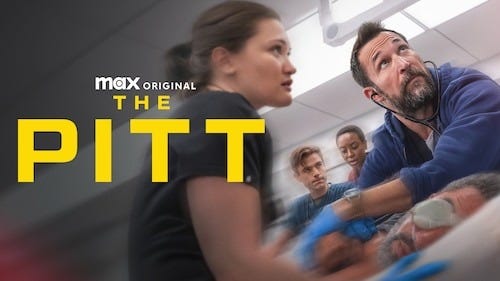
Above: Frenzy in focus.
The camera never stops moving.
It glides from gurney to gurney, patient to patient, crisis to crisis. It bandies about—here and there, up and down, left and right—never settling, never resting, never giving you permission to look away. There are no musical cues telling you how to feel. No establishing shots. No breathing room. Just the relentless, handheld choreography of an emergency room that refuses to slow down.1
HBO’s The Pitt is the best show currently on television. I say that with full confidence and zero confidence, because I can no longer tell whether the show is genuinely great or whether it has simply perfected the art of hijacking my brain.
The Dopamine Machine
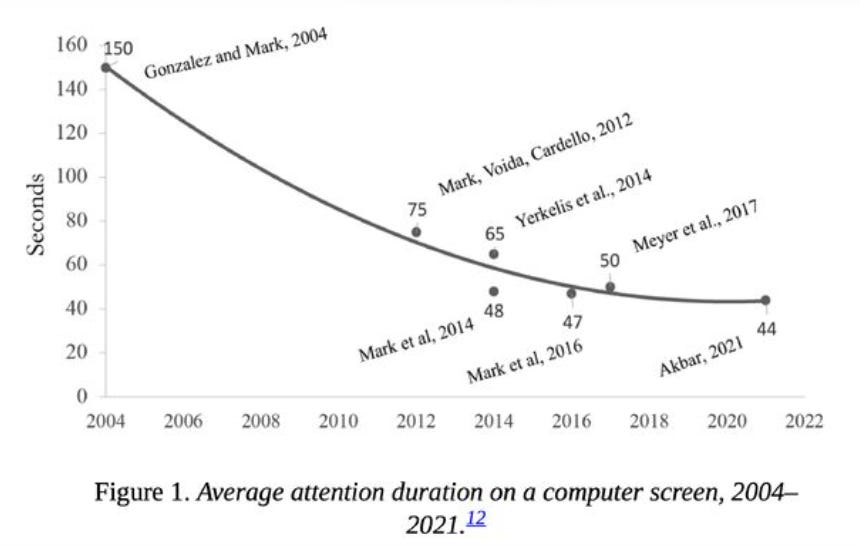
In 2004, the average human attention span on a screen was two and a half minutes. By 2012, it had dropped to 75 seconds. Today it sits at just 44 seconds. That’s a nosedive off a cliff.
TikTok did not cause this collapse, but it did build an incredibly formidable business model around it. Pediatricians now call the app a positively Pavlovian “dopamine machine” where each swipe delivers a micro-hit of neurochemical reward and each video trains the brain to expect information in 15-to-30-second bursts.
Researchers have found that heavy short-form video users show measurably reduced prefrontal executive function, the very brain region responsible for filtering distractions and sustaining focus. In a 15-minute TikTok session, a teenager may consume 60 different videos, each requiring a total shift in context, each preventing the brain from ever entering a flow state.
I’ve written before about how our shrinking attention spans have reshaped even which ancient philosophy we reach for; why Marcus Aurelius’ Meditations thrives in the scroll era precisely because it was already chunked into discrete, bite-sized fragments that exploit the same variable reward schedule as an algorithm.
Why Does Everyone Love Marcus Aurelius’ Meditations?

How a Roman Emperor Inadvertently Cracked the Influencer Code
The Pitt is the television version of that same phenomenon: content that succeeds because of our cognitive rewiring.
We have collectively reprogrammed ourselves to need the next thing, now, always.
TikTok Dressed up in Prestige Clothing
Each season chronicles a single 15-hour shift in a Pittsburgh emergency room. Each episode covers roughly one hour. The real-time conceit means there is no narrative compression, no “three weeks later.” You are locked in from the get-go.
But within that lock, the show is pure kinetic scatter. A dozen storylines compete for your attention in any given episode. A cardiac arrest interrupts a domestic abuse case which interrupts an opioid overdose which interrupts a quiet conversation about burnout. The camera—operated handheld all day, every day, on lightweight rigs designed for constant motion—follows one character and then abandons them mid-sentence to chase another down the hall. You are always being pulled somewhere new. In a way, the ER is a perfect metaphor for the feed.
One review compared the editing to the Safdie Brothers—the filmmakers behind Uncut Gems, a movie that was essentially a two-hour panic attack. That’s not a coincidence.
The Pitt uses the same toolkit: relentless pacing, overlapping dialogue, claustrophobic framing, the elimination of silence. The show’s creators deliberately stripped out almost all background music, replacing it with layered ambient sound—machinery, background conversations recorded from real ER nurses, the beeping of monitors—so that the environment itself becomes the rhythm.
Cinematographer Johanna Coelho described the production rhythm simply: “We just punch through. We don’t stop. We keep going all day.”
It is, in other words, a show built for brains that can no longer sit still. A show that gives you the constant novelty hit of scrolling your phone, but wrapped in prestige production values and real human stakes. TikTok in a hospital gown.
And I, for one, can’t stop watching.
The Business of More
The Pitt costs roughly $4 to $5 million per episode. For comparison, House of the Dragon runs upwards of $20 million per episode. Severance costs $20 million. Andor ran $21 to $22 million.
How? One set. The entire show takes place inside a 360-degree hospital built across multiple soundstages at Warner Bros. in Burbank. No location shoots. No CGI. No elaborate costume design. The wardrobe is scrubs. The set’s lighting is built into the ceiling so the camera can move freely in any direction without waiting for a crew to reposition equipment.
This efficiency means HBO can produce 15 episodes per season—nearly double the typical streaming order of eight—and return annually. In a landscape where fans wait two or three years between seasons of Severance or Euphoria and get half the episodes, The Pitt delivers twice the content at a quarter of the cost, every single year. HBO’s head of content called it filling “white space in the streaming landscape.” This allows for shows with longer seasons, modest budgets, and consistent annual returns. The network has already ordered a few pilots built on the same model.
The economics mirror the attention economy perfectly. More content, faster, cheaper, always. The same logic that drives TikTok’s infinite scroll drives The Pitt‘s production calendar. Keep them engaged. Reduce the wait. Never let them leave.
Sound familiar?

Needless to say, it’s working.
The Season 2 premiere drew 5.4 million viewers in three days—nearly triple the series debut. The show hit 939 million viewing minutes in its premiere week. It won the Emmy for Outstanding Drama. It won the Golden Globe. It is, as of this week, the number one show on all of streaming.
And yet, I still wonder.
The Pitt is undeniably well-made. The performances are extraordinary—Noah Wyle’s quiet devastation, Katherine LaNasa’s bruised resilience, Patrick Ball’s trembling vulnerability as an addict trying to come back. The writing treats healthcare workers with a seriousness and specificity that actual ER physicians say they’ve never seen on television. Real doctors describe certain scenes as triggering. That’s not a show coasting on cheap tricks.
However, I wonder whether part of what makes it feel so good is that it has been precision-engineered for a brain that can no longer tolerate stillness.
The show’s greatest innovation might not be its realism or its performances but its metabolism—the way it delivers emotional payload at a frequency perfectly calibrated to an attention span that has been shattered by a decade of infinite scrolling.
I love this show. I endorse it without reservation. You should watch it. Everyone should watch it.
But when I ask myself why I love it—whether it’s because the spectacle is genuinely transcendent or because the delivery mechanism has been optimized for our collective neurological damage—I don’t have a clean answer.
The camera keeps moving. I keep watching.
I’m not sure I could stop if I wanted to.
Per my about page, White Noise is a work of experimentation. I view it as a sort of thinking aloud, a stress testing of my nascent ideas. Through it, I hope to sharpen my opinions against the whetstone of other people’s feedback, commentary, and input.
If you want to discuss any of the ideas or musings mentioned above or have any books, papers, or links that you think would be interesting to share in a future edition of White Noise, please reach out to me by replying to this email or following me on X.
With sincere gratitude,
Tom
Pay close attention to your heartbeat and breathing after reading these sentences. This is The Pitt in written form.
I hadn't thought of it this way, but it's an interesting point of view. The show has no downtime, no breathers. Even a private psychological breakdown hiding in an empty examination room gets barged in on. There's no time to parse or digest anything, so things are spelled out for you. That's the TikTok effect. If everything is cranked up to 11, you get numb watching it, which is actually a reflection of what social media does to us too. It flattens out experience. Instead of engaging with it intellectually, the way you might with 'Pluribus' or 'Severance', you're busy memorizing cool acronyms. There isn't even time for the soapier elements the older generation medical shows always had. Behind the medicine was another layer (romantic tropes, etc.) made to humanize the doctors and add another layer of interest. Shows like 'House' would pause the medical plot for philosophical arguments, sarcastic banter, moral debates or quiet character moments. Those pauses gave viewers time to process what just happened.
By contrast, 'The Pitt' appears to be designed around continuous escalation. It has elements signaling depth, like fast food imitating food. The fact that it solves multiple streaming platform dilemmas at the same time forced the show to become a new business model, and that means we are going to continue to see this kind of industrialized TV storytelling.
Love the bit about Aurelius as precursor to doomscrolling