

I will work harder!
—Boxer, Animal Farm
Totalitarianism means that everything serves politics; everything becomes a tool. This is what ‘total work’ means: everything serves work...We tend to overwork as a means of self-escape, as a way of trying to justify our existence.
—Josef Pieper

Above: Comrade Claus, reporting for never-ending duty.
What does Santa actually do?
Think about it. He makes a list. He checks it twice. He oversees a workshop full of laborers who never sleep, never complain, never ask for a raise. When they’re finished, he manages the delivery. He gets the kisses from Mrs. Claus, the gallons of milk, the dozens of cookies, and the timeless songs that captivate a grateful globe year in and year out.
He doesn’t make the toys.
The most beloved figure in Western childhood is a middle manager with a great brand. He runs a sweatshop at the North Pole (the irony is so sweet that you can taste it) and somehow we sing about it.
Silicon Valley is building the North Pole. AI is the elf. You (the engineer, the marketer, the writer, the strategist, the knowledge worker) are being promoted to Santa.
Your new job is the long, winding, interminable list.
And the list never ends. Christmas is just Santa’s torturous treadmill: just as one year closes, the next one opens. His only true day off is December 25th, and even that is a day of delivery, logistics, and dissemination. The man gets no offseason. Just another list.
Merry Christmas! Now get back to work in the coldest circle of holly jolly hell.
Recall how it felt before the promotion.
First drafts of projects and papers and presentations used to take all day. Your work led to bad ones, downright dreadful ones, even clumsy ones. But the clumsiness was where something happened. You’d push through a wall and find the idea you didn’t know you were looking for.
Just like that, four hours would vanish and you would enter flow—that wondrous state psychologists can measure but can’t manufacture, the place where skill meets challenge and time simply melts away.
Training Until Failure, Thinking Until Fatigue

When you offload the struggle to machines, you might get clarity faster, but you lose the capacity that clarity comes from. You skip the pressure that turns graphite into diamond.
The AI workflow replaces all of that with something else. You prompt. You wait. You read what comes back. You squint at it.
Is this right? Sort of.
Is this good? Kind of.
What’s wrong with it? Hard to say. Something.
You fix a sentence. You re-prompt. You read again. You approve.
You have become a building inspector for houses you didn’t build. The houses look fine. You won’t know until someone moves in and the pipes burst at 3 AM.
Making things fills you up. Checking things hollows you out.
Every person who has ever written something knows the difference between the day you wrote five pages and the day you copyedited someone else’s five pages. One sends you to bed tired and satisfied. The other sends you to bed tired and irritable.
AI turns every worker into a copyeditor. The cruel part is that nobody ever dreamed of becoming one.
No kid said when I grow up, I want to review other people’s work for a living. But that’s the promotion AI is offering.
A software engineer named Siddhant Khare recently wrote about what this feels like on the ground. His summary of the paradox is worth quoting at length:
AI genuinely makes individual tasks faster. That’s not a lie. What used to take me 3 hours now takes 45 minutes. Drafting a design doc, scaffolding a new service, writing test cases, researching an unfamiliar API. All faster.
But my days got harder. Not easier. Harder.
The reason is simple once you see it, but it took me months to figure out. When each task takes less time, you don’t do fewer tasks. You do more tasks. Your capacity appears to expand, so the work expands to fill it. And then some. Your manager sees you shipping faster, so the expectations adjust. You see yourself shipping faster, so your own expectations adjust. The baseline moves.
Before AI, Khare would spend a full day on one design problem. Sketch on paper. Think in the shower. Walk around the block. Come back with clarity. One problem, one day. Now he touches six problems before lunch, because each one “only takes an hour with AI.” But context-switching between six problems is brutal. The AI doesn’t get tired between problems. He does.
He put his finger on the exact inversion:
Before AI, my job was: think about a problem, write code, test it, ship it. I was the creator. The maker. That’s what drew most of us to engineering in the first place — the act of building.
After AI, my job increasingly became: prompt, wait, read output, evaluate output, decide if output is correct, decide if output is safe, decide if output matches the architecture, fix the parts that don’t, re-prompt, repeat. I became a reviewer. A judge. A quality inspector on an assembly line that never stops.
His conclusion was blunt: AI reduces the cost of production but increases the cost of everything else. And the “everything else” falls on you, Mr. Claus.
Santa doesn’t just check the list. He inspects every toy. And the toys just keep on a-coming.
None of this is new. The math was worked out in Victorian England.
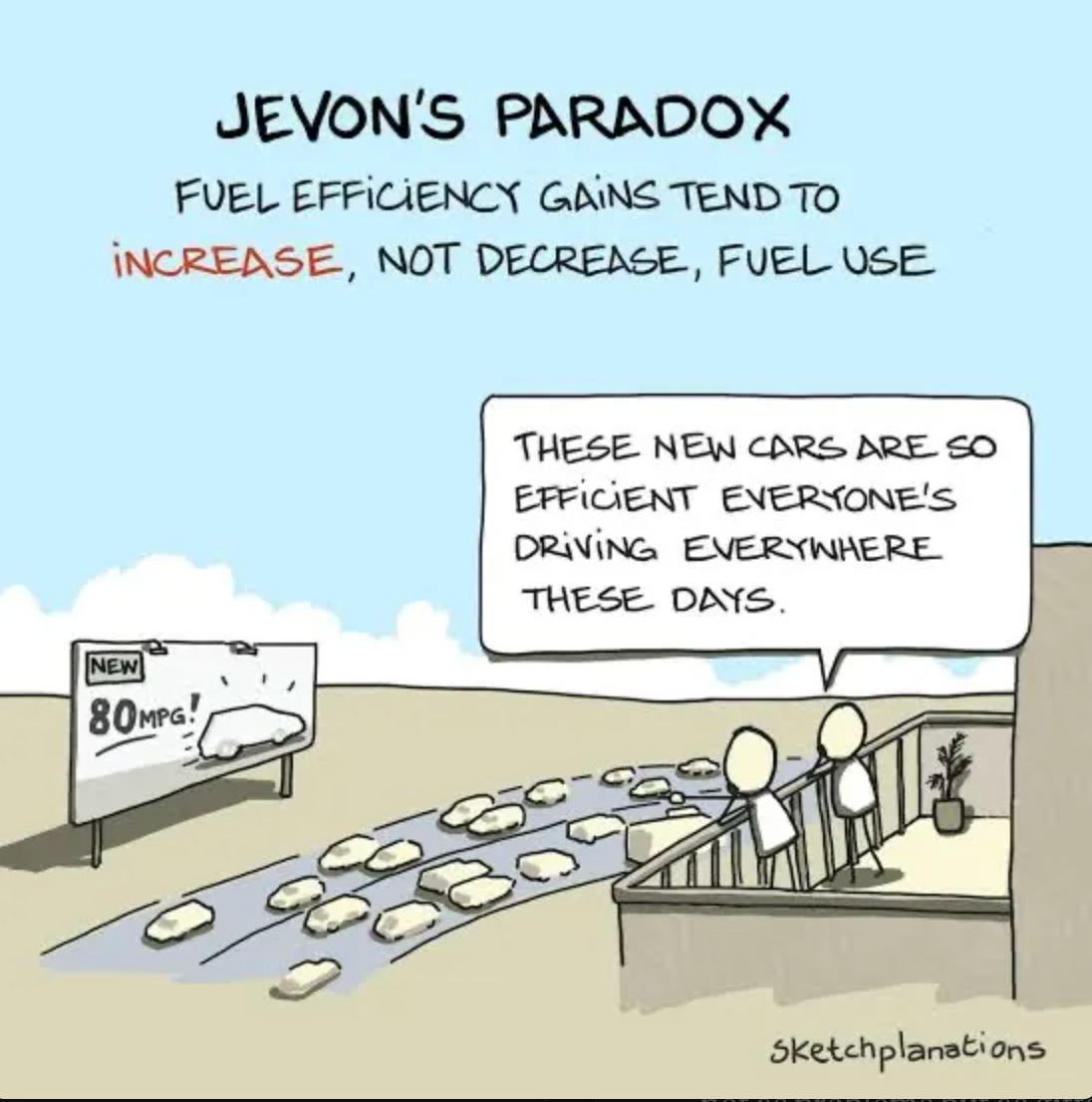
In 1865, British economist William Stanley Jevons noticed something strange. England had gotten dramatically better at using coal. New steam engines extracted more work from less fuel. You’d think England would use less coal.
England used more. Much more.
Efficiency didn’t reduce consumption. It reduced cost. And when cost drops, demand doesn’t hold steady. It explodes. Coal became viable for things nobody would have burned it for before and the savings plowed into ever more coal.
This became known as Jevons’ Paradox: making a resource cheaper to use doesn’t conserve it. It devours it.
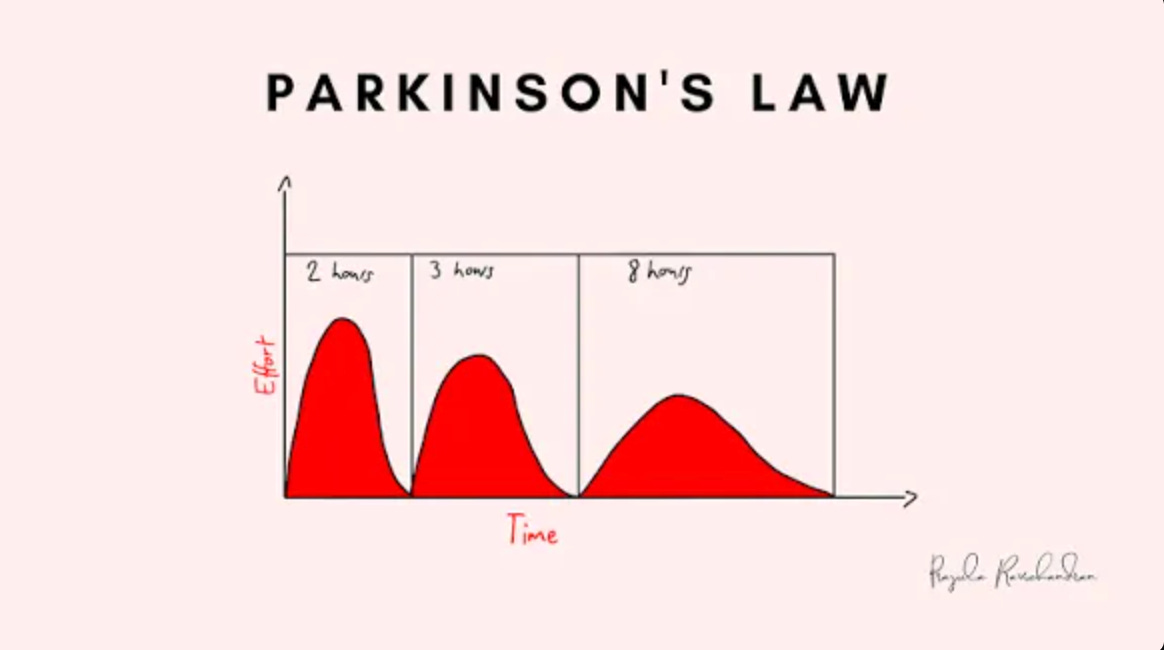
Parkinson saw the other half. C. Northcote Parkinson was a British naval historian who, in 1955, opened an essay in The Economist with a sentence that became more famous than anything else he ever wrote: “Work expands so as to fill the time available for its completion.” He’d watched the British civil service grow and grow even as the Empire it administered shrank and shrank. Fewer colonies, more bureaucrats. His law was a joke. It was also obviously true. Give a team a week to do what could be done in a day, and somehow the week fills up. Meetings breed. Scope creeps. Bureaucracy thickens.
These aren’t parallel observations. They intersect with unimaginable consequences.
The collision of Jevons’ Paradox with Parkinson’s Law is a perfect catalyst for complete, utter, deadening, soul-sucking burnout. Work expands infinitely when AI removes any and all barriers (whether cost or effort) leaving nothing to stop the flood.
AI makes cognitive work nearly free to produce.
Jevons: because it’s cheap, we produce absurd quantities. The volume of output metastasizes because nothing stops it.
Then Parkinson: the management of all that output expands to fill every hour we supposedly saved. You don’t get your afternoon back. You get a second shift. The first shift is prompting while the second shift is sorting through what came out.
The elves are tireless. That’s the problem. Santa never gets to go home. Somewhere along the way, Ho Ho Ho turns into Oh Hell No.
Traditional burnout comes from doing too much. AI burnout comes from doing too much of nothing, from spending your days evaluating outputs you had no hand in creating. Full of decisions yet empty of making.
There is something honest about being tired from work you did yourself.
There is something poisonous about being tired from work you supervised.
Byung-Chul Han saw this before the tools arrived. As I wrote previously, Han diagnoses the inner mechanics with surgical precision:
The society of laboring and achievement is not a free society. It generates new constraints. Ultimately, the dialectic of master and slave does not yield a society where everyone is free and capable of leisure, too. Rather, it leads to a society of work in which the master himself has become a laboring slave. In this society of compulsion, everyone carries a work camp inside. This labor camp is defined by the fact that one is simultaneously prisoner and guard, victim and perpetrator. One exploits oneself.
AI finishes what Han diagnosed. The old exploitation came from outside in the form of a boss, a system, a quota. You could point at the thing grinding you down.
AI exploitation comes from inside. Nobody forces you to prompt the machine at 11 PM. Nobody makes you generate a fifth variation of the deck. You do it because you can. Because the tool is sitting there, the distance between “done” and “more” has collapsed to zero, and your own ambition won’t let you stop.
Then, just like that, you have become prisoner, guard, and ever-open workshop all in one.
You see, AI eliminates any and all natural stopping points. Like a bull with indestructible horns, the knowledge worker barrels through every hindrance, every pothole, every roadblock, powered by an indefatigable miracle made of sand.
You used to stop writing when you were tired. When you hit a wall. When your skill ran out. Those were organic limits built into the act itself. You couldn’t keep going because you couldn’t keep going. The constraint was human. It was also, quietly, a mercy.
AI removes the constraint. The machine doesn’t get tired. It doesn’t hit walls. And so the only thing standing between you and infinite output is your willingness to keep going.
Willingness is a terrible fence.
Don’t believe me? Look at screen time.
Americans already spend seven hours a day staring at their phones, tablets, and computers. Over half say they want to cut back. They don’t. If we can’t tear ourselves away from the supercomputers in our pockets—devices that merely entertain us—imagine the agony of disconnecting from superintelligence that does our jobs (let alone our thinking) for us.
Soon enough (pun intended), enough will be the most expensive word in the AI economy because everything around you will punish you for saying it. If you can produce more, and your competitor is producing more, then the standard of “done” dissolves. There is always another variation. Another draft. Another angle. The machine will always say yes.
As Packy McCormick wrote:
Here’s the hard thing about easy things: if everyone can do something, there’s no advantage to doing it, but you still have to do it anyway just to keep up...
When every rebel is armed, none really is. It’s like when you played GoldenEye 007 as a kid. Getting the Golden Gun the hard way was dope. Everyone getting the Golden Gun with a cheat code made the game suck.
You have to be the one who says no without any of the cues that used to say it for you.
Santa’s got a great gig, we’re told. He doesn’t have to make the toys anymore.
Nobody asks whether making the toys was the point.
The elves work in the background. They don’t need sleep. They don’t need meaning. They don’t need to feel the satisfaction of a thing made well. They just produce.
Somewhere above them, reading the list, checking it twice, scrolling through outputs he didn’t make and can’t quite evaluate, Santa sits in his workshop.
He used to be a master craftsman.
Now he’s a logistics coordinator with a brand.
We’re all becoming him.
We will surely be fat. The jury is still out on jolly.
What is certain is that the belly laugh of ho ho ho will morph into the panting heh heh heh of a man fondly recalling his past, hating his present, and dreading his future. This new era of work is total, consuming, deadening—and it leaves no room for the one thing that might actually save us.
Kurt Vonnegut once told a story about Joseph Heller that I think about all the time:
True story, Word of Honor:
Joseph Heller, an important and funny writer
now dead,
and I were at a party given by a billionaire
on Shelter Island.
I said, “Joe, how does it make you feel
to know that our host only yesterday
may have made more money
than your novel ‘Catch-22’
has earned in its entire history?”
And Joe said, “I’ve got something he can never have.”
And I said, “What on earth could that be, Joe?”
And Joe said, “The knowledge that I’ve got enough.”
Not bad! Rest in peace!
Enough is neither a productivity hack nor a time management strategy. It’s a countercultural philosophical position. It might also be a lifeline.
It means accepting that you could do more and choosing not to; treating your limits not as problems but as gifts; and deciding that the point of work was never the output, but the work, itself.
Let the elves have the toys.
I’d rather make something with my hands.
Per my about page, White Noise is a work of experimentation. I view it as a sort of thinking aloud, a stress testing of my nascent ideas. Through it, I hope to sharpen my opinions against the whetstone of other people’s feedback, commentary, and input.
If you want to discuss any of the ideas or musings mentioned above or have any books, papers, or links that you think would be interesting to share in a future edition of White Noise, please reach out to me by replying to this email or following me on X.
With sincere gratitude,
Tom
Truly horrific and dystopian. I felt even more helpless reading this. A pendulum swing between two extremes.
Love the Santa analogy. I often think about AI like the innovation of cars. Cars let us travel for indefinite periods throttled solely by our capability to maintain our attention to the activity. We still walk and bear the limits of walking distances when doing so but stopped looking at walking as a way to get places and instead a form of personal gratification. Walking becomes almost an indulgence. Feels like thinking is getting that way. If you aren’t using AI you are being wasteful despite the irony of AI being immensely wasteful of resources required for life like energy and water.