

Any sufficiently advanced technology is indistinguishable from magic.
—Arthur C. Clarke
He who controls the spice, controls the universe.
—Frank Herbert
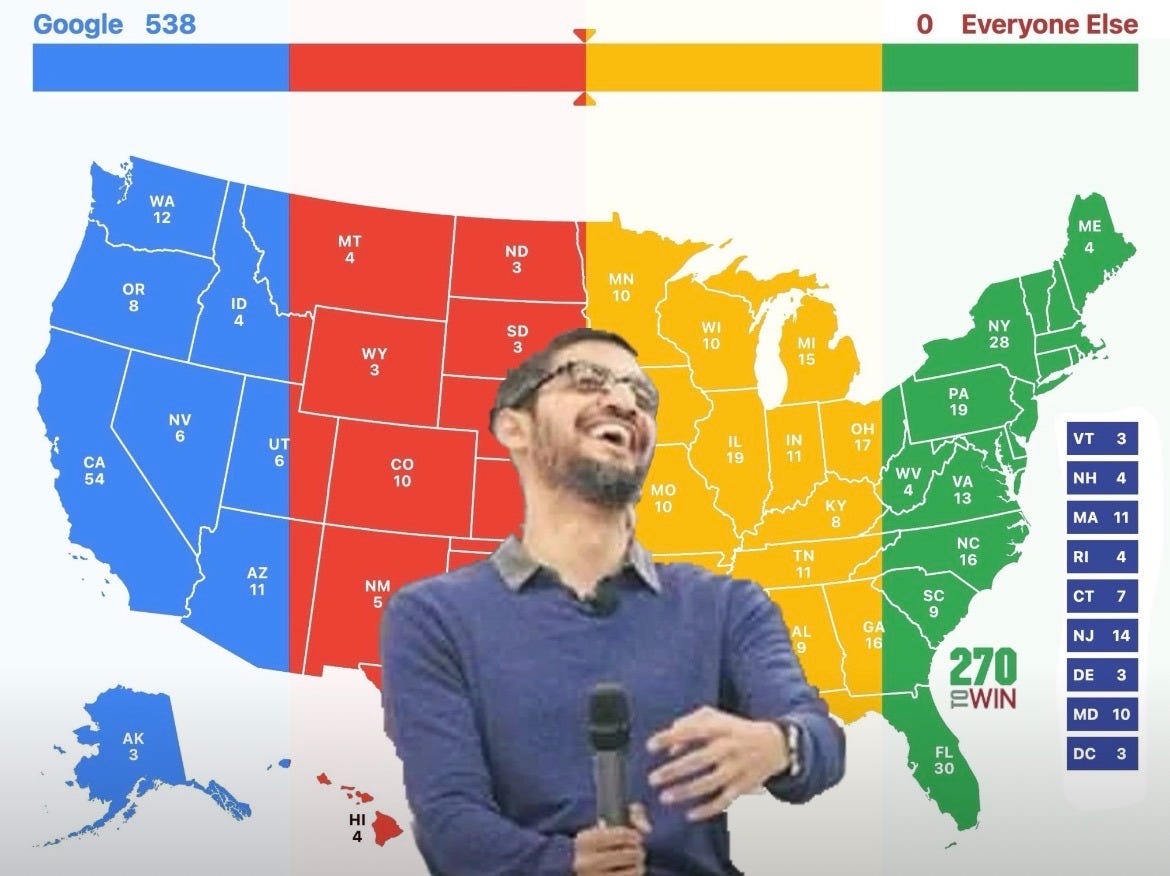
Above: Coming soon to Already on a screen near you!
I recently posted a writeup on LinkedIn that gained some unexpected traction:
OpenAI’s “Code Red” reminds of Zuck’s “Carthago delenda est” moment in the wake of the Google Plus launch.
The companies shared the same foe, but I don’t think OpenAI will be as lucky as Meta was.
Google is the best risk-reward trade in AI. Full stop.
Why?
Because unlike every hype-drunk AI company that burns money to buy relevance, Google is:
—A default-layer monopoly.
Search, Android, Chrome, Maps, YouTube are the trade routes and toll roads of the digital world. When AI becomes infrastructure, the company that owns the ports wins.
—A vertically integrated AI factory.
Chips (TPUs), models (Gemini 3), cloud, data, incipient energy deals, and global distribution all under one roof. Other companies would need years to replicate this.
—A cash machine masquerading as a tech company.
Tons of free cash flow, fortress margins, mammoth share buybacks…and an (admittedly tiny) dividend that makes it as safe as cash in an inflationary world, except it actually grows.
—The anti-bubble play.
If AI overheats, Google still wins. If AI matures, Google wins even more.
In AI, the long-term winner is the one who becomes the default.
Google already is given its technology, distribution, and balance sheet.
It resonated with some and struck a nerve with others because it challenges the punch-drunk hype cycle with a boring truth: innovation seldom beats distribution.
Any veteran founder worth his salt will treat this as gospel; as Justin Kan incisively quipped, “First time founders are obsessed with product. Second time founders are obsessed with distribution.”
Nothing better represents scale, distribution, and ubiquity than the humble vending machine. It offers a perfect analogue for how we adopt and embrace (and then abuse) technology.
The Vending Machine Theory of AI
A short while back, Rex Woodbury wrote a brilliant piece on the history of “smart contracts,” tracing the term back to cryptographer Nick Szabo in the 90s.
Interestingly, Szabo used the vending machine as his primary example.
As Woodbury writes:
Vending machines are important because they’re easy to use. Most people don’t understand how a vending machine works, and yet the average person spends $62 at a vending machine each year. Vending machines abstract away all complexity.
People don’t need to understand the inner-workings—unless, perhaps, they’re a vending machine repairman...But people understand enough: you put money in and a can of soda comes out. That’s all that matters.
This is what Web3 needs: elegant products that abstract complexity. The path to onboarding billions of people to Web3 means making things so painstakingly simple that anyone can use them.
I wrote about why most people will never know that Web3 exists, and why that’s actually a good thing. The vast majority of people will never know that they’re interacting with a blockchain, as the complexities are hidden beneath beautiful and familiar interfaces…that’s the opportunity to go after.
While Woodbury applied this to crypto, it is the perfect metaphor for the end-state of AI.
Right now, using AI feels a bit like being a vending-machine repairman.
We “prompt engineer.”
We tweak phrasing.
We choose models.
We babysit outputs.
Intelligence, at this stage, lives somewhere else.
We treat it like a destination.
We leave our work.
We open a new tab.
We “commute” to ChatGPT, Claude, Grok, or whatever model happens to be fashionable this quarter.
That alone tells you we’re early
Humans reliably take the path of least resistance. Unless a tool is meaningfully better—orders of magnitude better—we don’t change our behavior. We adopt what meets us where we already are, inside the interfaces we already inhabit. Inertia, as it turns out, is not only a law of physics, but also of humanity
This is why the chat interface worked as well as it did. It was a Trojan Horse—intuitive, conversational, non-threatening. But it’s still a place you have to go. A separate ritual. A conscious act.
The next phase doesn’t require intention or interruption.
The vending machine phase provides intelligence that is ambient, embedded, and already there—always on, always available, quietly doing its work in the background, wherever you happen to be
The Invisible Empire
If LLMs are becoming a commodity, the winner of the great AI race will be the company that owns the layer between the user and the commodity.
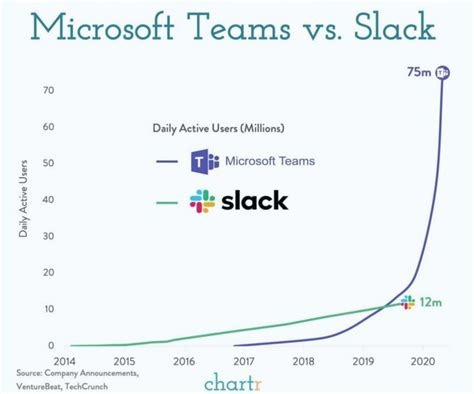
Case in point: Slack versus Microsoft Teams. The former got all the buzz as the innovative first mover, while the latter hoovered up all the users and revenue because of distribution and deep pockets.
MIT Technology Review captured how Google is replicating this strategy in their recent headline: “By putting AI into everything, Google wants to make it invisible” — it reads:
This is the new frontier. It’s no longer about who has the most powerful models, but who can spin them into the best products. OpenAI’s ChatGPT includes many similar features to Gemini’s. But with its existing ecosystem of consumer services and billions of existing users, Google has a clear advantage…On a preview call, CEO Sundar Pichai claimed that AI Overviews, a precursor to AI Mode that provides LLM-generated summaries of search results, had turned out to be popular with hundreds of millions of users. He speculated that many of them may not even know (or care) that they were using AI—it was just a cool new way to search. Google I/O gives a broader glimpse of that future, one where AI is invisible.
“More intelligence is available, for everyone, everywhere,” Pichai told his audience. I think we are expected to marvel. But by putting AI in everything, Google is turning AI into a technology we won’t notice and may not even bother to name.
The goal isn’t to have you converse with a bot, but to absorb the bot into the product itself. Google has the breadth and depth to do that in spades.
Back in 2024, Google CEO Sundar Pichai wrote, “We have six products with more than 2 billion monthly users, including 3 billion Android devices. Fifteen products have half a billion users. And we operate across 100+ countries.”
Couple this with its quiet ownership of every layer of AI’s value chain..
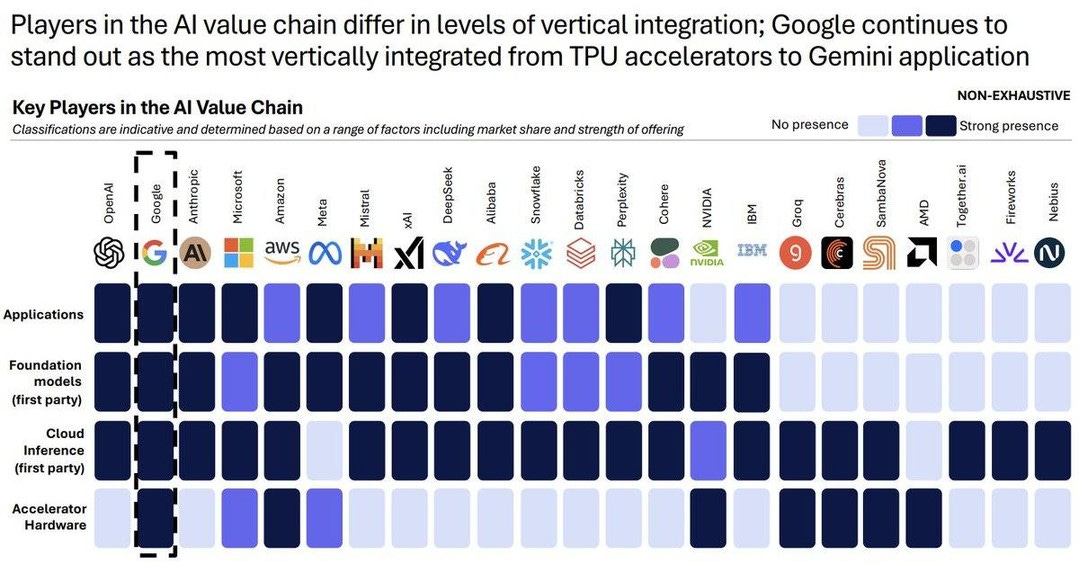
…and Google sure looks like both the unstoppable force and immovable object all in one.
Per Tech Policy Press:
What differentiates Google is its existing ecosystem of products, which have become infrastructural for most consumers. ChatGPT loses at least $2 for every $1 it spends, and, as Brian Merchant wrote for AI Now, the company fails to have a discernable or profitable business model. Now, as AI increasingly becomes more expensive to integrate into products, firms who are best positioned to succeed are those who have alternative revenue streams to offset costs, profit off of high compute costs, or those who can easily integrate AI into their existing product workflow. Google is able to take capital intensive risks on AI because of its ongoing search monopoly profits. By owning Google Cloud, Google can discount the costs of running its own models. And finally, Google can integrate AI into all of its existing products, tapping into a user base of billions. In fact, a Google executive testified in this case that Google has already integrated generative AI into every single one of Google’s products—again giving the company an impossibly strong upper hand on those AI start-ups listed as competition.
We are moving toward a world where the interface is the product. When the model behind the scenes becomes interchangeable, the value shifts entirely to availability and accessibility.
Google is uniquely positioned to offer this because they own both the “ports” and the “toll roads” of the digital world.
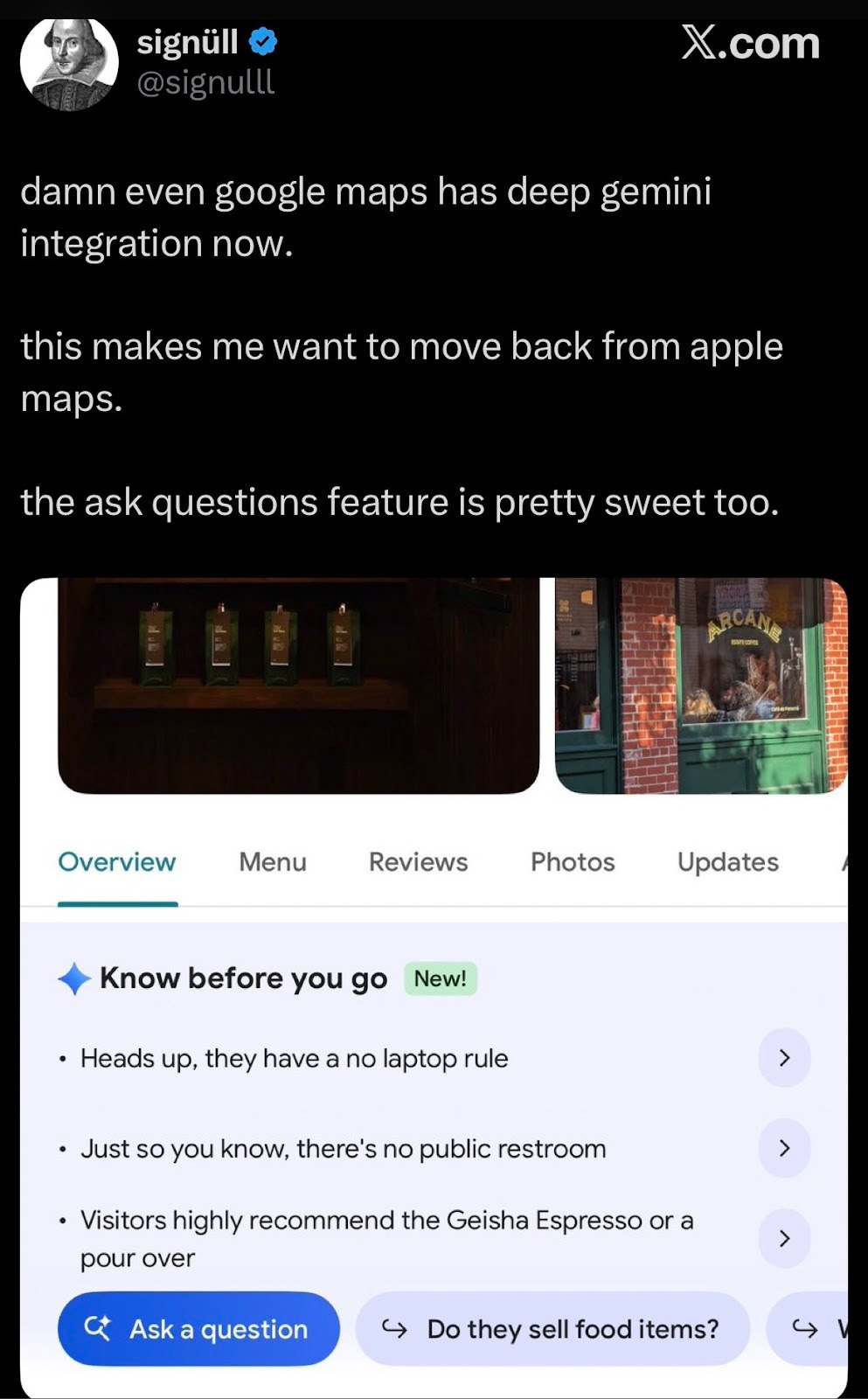
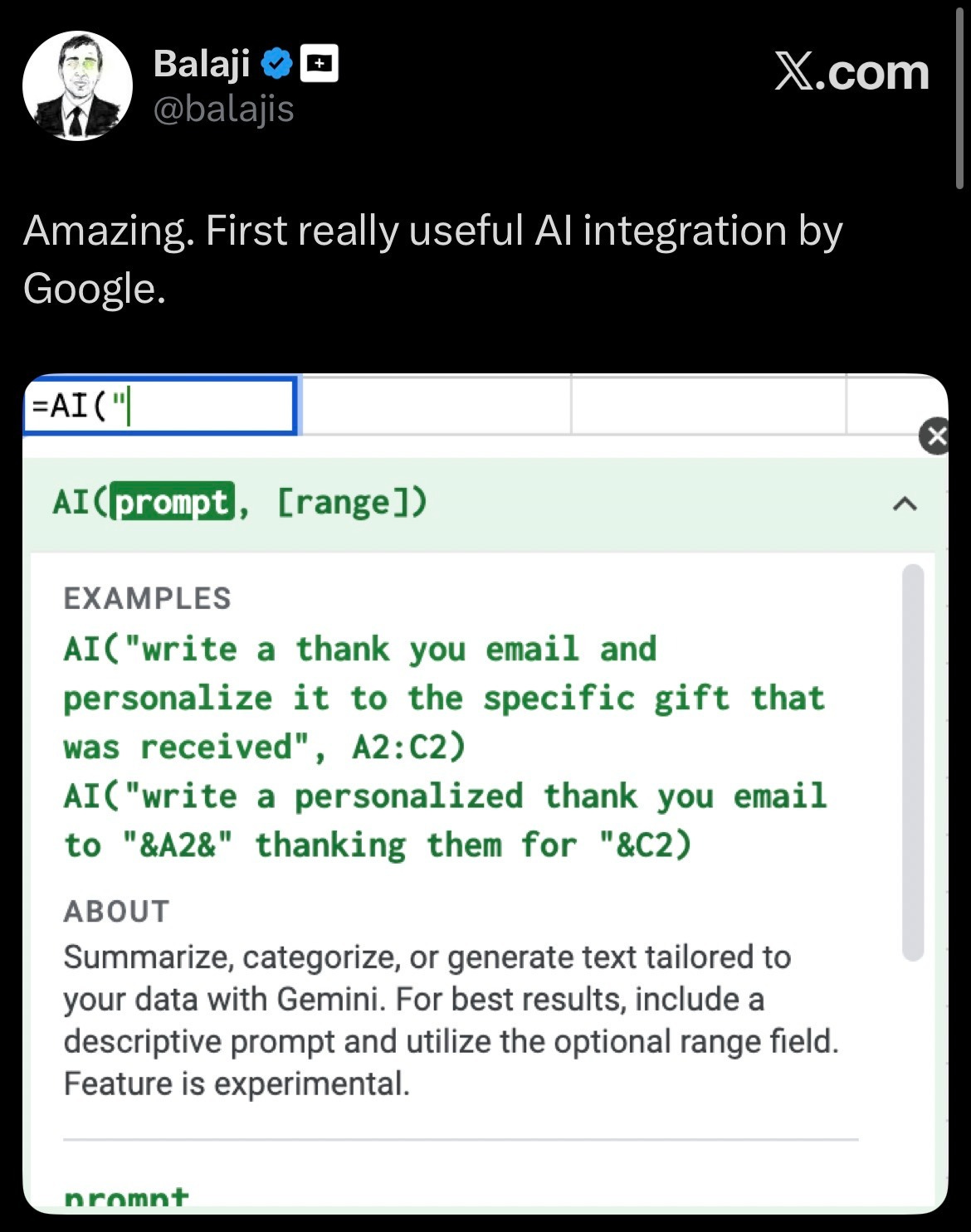
Think of these AI-enabled functionalities as barnacles on a boat or remoras beneath a shark.
They are not the vessel itself; they are merely attachments. They survive and thrive because they have latched onto a host that is massive, established, and—most importantly—going nowhere.
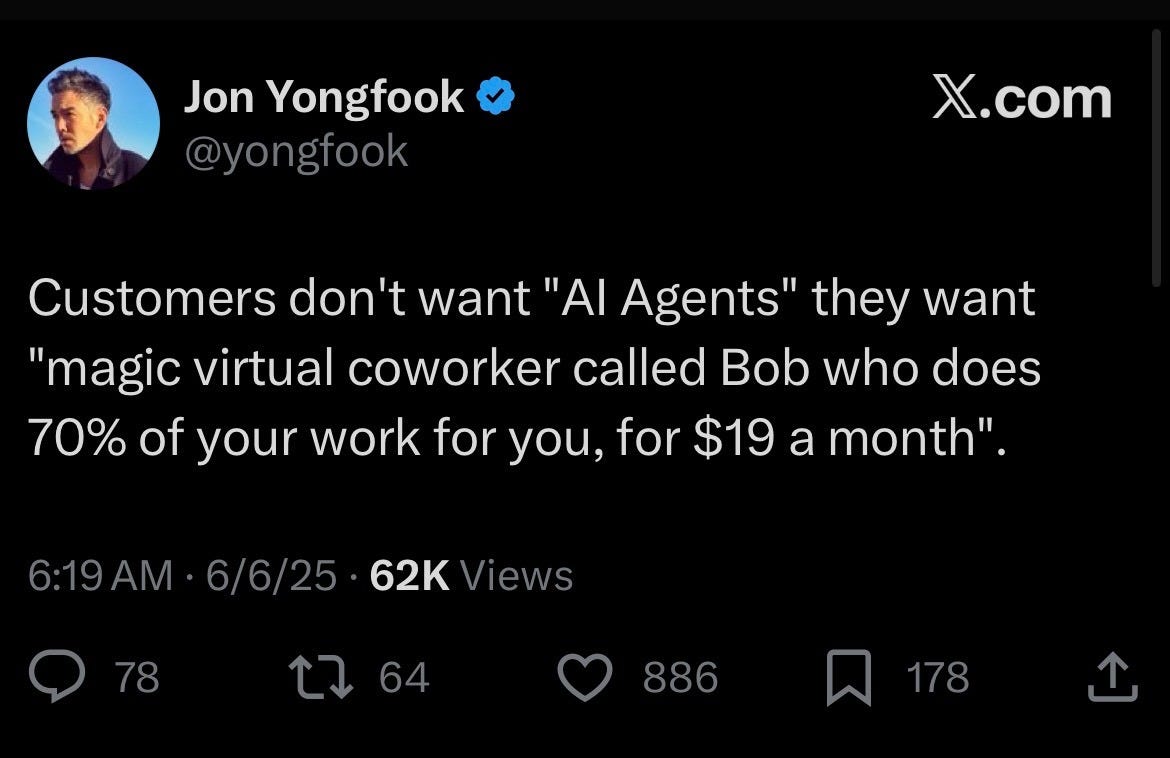
From “AI Companies” to “Bob”
AI is headed from novelty to utility to ubiquity to invisibility. As it turns out, the best UI is no UI at all.
When AI finally does disappear into the background—when it becomes plumbing instead of performance, necessity instead of novelty—that’s when it wins.
Google understands this instinctively; that’s why the great multicolored mass is absorbing AI, not selling it as aggressively as it could.
Per Mr. Yongfook:
True to form, Google is putting on a marketing masterclass.
Instead of telling you what Gemini is, it shows you what it does.
That’s the cardinal rule of great marketing: never explain the product—demonstrate the outcome.
Speaking of marketing, in the next year or so I suspect we will stop talking about companies as “AI companies” or “non-AI companies.” The AI will be assumed. We don’t talk about JavaScript or Python or C++ companies, after all.
Sequoia’s Konstantine Buhler captured this eloquently:
The ultimate sign of success for AI? When we stop calling it AI.
Once a system is reliable and mainstream, we just call it ‘technology.’ We’ve seen this with spam filters, speech recognition, chess engines, route optimization, and even autocorrect—all were once considered cutting-edge AI. Today, they’re just features we expect to work.
Today’s AI breakthroughs are simply tomorrow’s standard software.
As the cutting-edge continues to dull, convenience reigns supreme.
If you are writing an email in Gmail, you don’t want to open a separate tab to ask a bot to rewrite it. You want the Vending Machine right there in your inbox.
If you are analyzing data in Google Sheets, you don’t want to export a CSV, upload it to ChatGPT, and beg for a formula. You want the Vending Machine to analyze the trend inside the cell.
If you are building a deck in Slides, you don’t want to toggle to Midjourney to generate an image, download it, and re-upload it. You want the Vending Machine to generate the visual on the slide.
If you are watching a tutorial on YouTube, you don’t want to copy the transcript into a summarizer. You want the Vending Machine to give you the key takeaways below the player.
OpenAI requires you to get up, put on your boots, walk to the store, make small talk with the clerk, and head back home.
Google is plunking the vending machine down right in your living room.
By the time you’re thirsty, the choice has already been made for you.
Per my about page, White Noise is a work of experimentation. I view it as a sort of thinking aloud, a stress testing of my nascent ideas. Through it, I hope to sharpen my opinions against the whetstone of other people’s feedback, commentary, and input.
If you want to discuss any of the ideas or musings mentioned above or have any books, papers, or links that you think would be interesting to share on a future edition of White Noise, please reach out to me by replying to this email or following me on X.
With sincere gratitude,
Tom
Isn’t Microsoft doing essentially the same with its AI built into products like PowerPoint and others in the Office suite?
It will indeed become a commodity and he who owns the ports wins. Netflix is buying Warner Bros. Three dudes working in the metaphysics space on the intersection of consciousness and technology were Itzhak Bentov, Jacobin Grinberg and Michael Talbot. Two died, the third went missing. I reference them because of the intro quote by Arthur C. Clarke which I frequently use too.