

There's only two ways I know of to make money: bundling and unbundling.
—Jim Barksdale
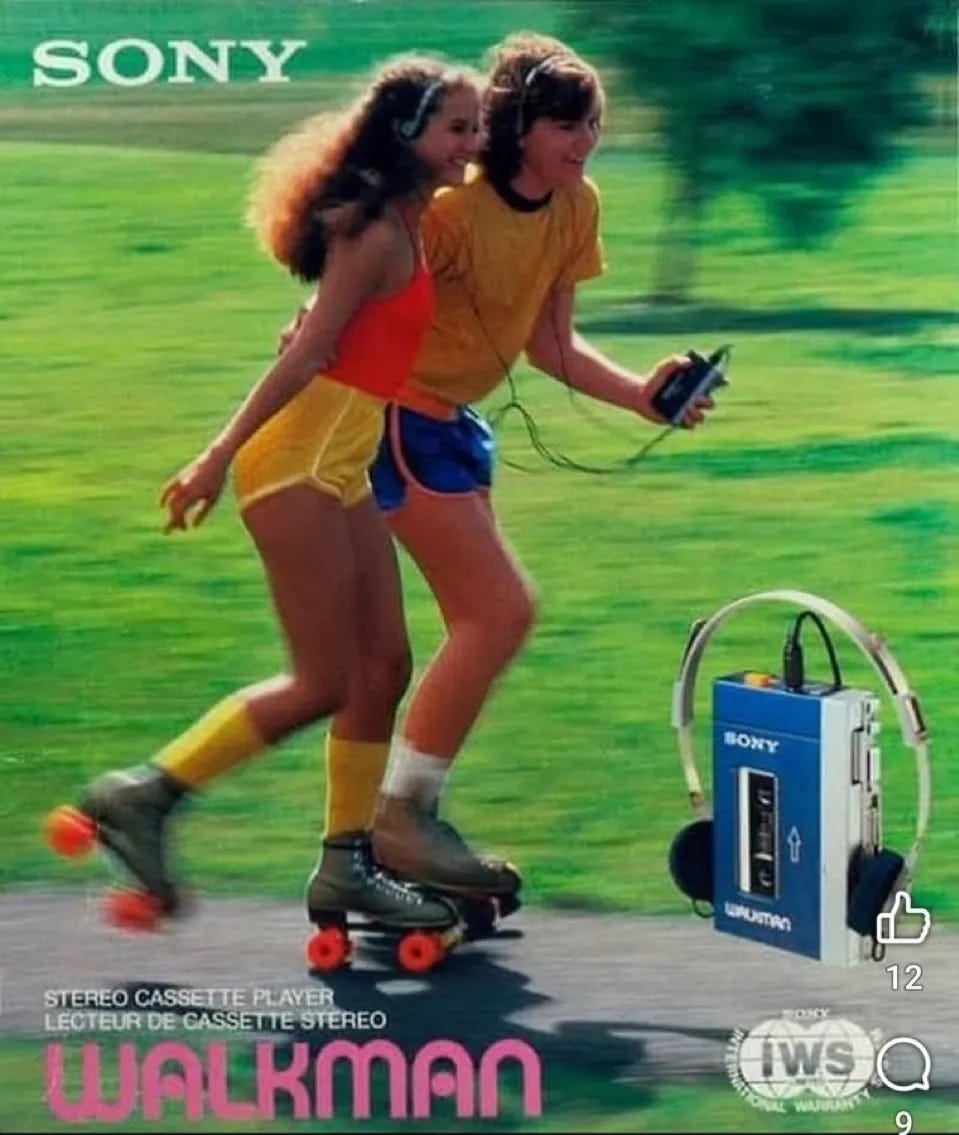
Above: Heaven is a place on earth.
I was vacuously sharpening a pencil the other day when something about the experience stopped me.
The pencil sharpener has not been improved in over a hundred years. Nobody has added Bluetooth to it. It doesn’t need firmware updates. It doesn’t ask for my email. You put the pencil in, you turn it, you get a sharp pencil. The transaction is complete. There is nothing left over. No notification, upsell, or suggested content based on your previous sharpening history.
It just does one thing. And then it’s done.
As I stood there, I realized that almost nothing else in my life works like this anymore.
Your phone is a Cheesecake Factory menu. Nineteen laminated pages. You came for pasta. You leave an hour later with a headache, a stomachache, and a doggy bag full of fried avocado egg rolls you never wanted. That’s every device you own now.
Your refrigerator has a touchscreen.
Your toaster wants Wi-Fi.
Your watch wants to be your phone, your wallet, your compass, your therapist.
The assumption underneath all of it is simple and wrong: more capability means more value. It doesn’t. More capability means more decisions. And more decisions, past a certain threshold, means less doing. It means aimlessly standing in front of the open refrigerator of your own life, scrolling.
We often think we want an open road. But sometimes what we need is a tunnel.
WHOOP understood this.
When Will Ahmed founded the company at Harvard in 2012, the entire wearable market was racing to become the next smartphone. Bigger screens, more apps, more notifications, more reasons to look at your wrist instead of the person across from you. Ahmed went the other direction. WHOOP has no screen. It measures strain, recovery, and sleep. That’s it.
When everyone told him to add a screen, especially after the Apple Watch launched, he refused. He knew that a screen on a health tracker would just lead to scope creep. It would turn a tool for focus into another vector for distraction. The closed loop was the point.
Here he is explaining why:
The market agreed. WHOOP just raised $575 million at a $10.1 billion valuation. Its investors include the athletes who actually wear it: Cristiano Ronaldo, LeBron James, Rory McIlroy. They don’t want another screen on their wrist. They want one thing done better than anything else.
This is the principle: do one thing. Do it well. Then stop.
As I wrote above, the internet runs on two alternating cycles: bundling and unbundling. We are at peak bundle. Your phone is a camera, a calculator, a calendar, a level, a compass, a flashlight, a library, a casino, a dating service, a confessional, and a surveillance device. Everything is everything. And the result is that nothing is anything. We are drowning in capability and starving for intention.
The unbundling is coming. You can already see it.
A former SpaceX engineer quit his job to build an $80 plastic-free steel coffee maker and the internet lost its mind. No app connectivity. No smart features. Just a machine that makes coffee and doesn’t poison you with microplastics.


Maxell is selling portable cassette players again and they immediately sold out.


Vinyl sales hit $1 billion in the U.S. in 2025 for the first time since 1983, outselling CDs for the fifth consecutive year. In a world of infinite content, infinite choice, and infinite scroll, people are starting to want things that end.
Finite formats and physical products with clear boundaries. No algorithm deciding what comes next. The closed loop is more than a feature, it’s the whole point.
In a world designed to distract you, monofunctional products are a way to regain focus amidst frenzy.
Freedom is not propping every door half open. Freedom is choosing one door and walking all the way through it. Fifteen thousand titles on a streaming service is not freedom. It is twenty minutes of paralysis followed by a rerun you’ve already seen. Five invitations in one week, all answered “maybe,” is not optionality. It is the inability to be fully present for any of them.
When you refuse to choose, choice chooses for you. And it always chooses badly.
Monks take vows because they understand that limitation is the precondition of depth. You cannot go deep on everything. You can only go deep on one thing at a time. The Cheesecake Factory menu just makes you fat, lethargic, and deeply unhappy.
Consider the book. The physical, paper, ink-on-a-page book.
It has virtually infinite battery life.
It is extremely shock resistant and can survive a ten-foot drop onto concrete.
It is fully random access with the ability to add notes.
It boasts a high-contrast display and is saddled with no terms of service, no subscription fees, no cookies, no ads, no updates, no surveillance.
It never crashes.
It has never had a minute of downtime in recorded history.
No one can revoke your access or alter the text after you buy it.
As Ted Gioia put it: the book is the ultimate killer app. It is the greatest hard storage concept in human history, and nothing else comes close.
The book is not primitive technology. It is perfected technology, the most advanced monofunctional device ever built. Five hundred years of innovation have not improved on it.
That is the standard. That is what we should be building toward, not away from.
I don’t want my refrigerator to have a brain.
I don’t want my blender to talk to me.
I especially don’t want my toaster to achieve sentience.
Hell, if I wanted a Brave Little Toaster, I would fire up the DVD player.
Some friction is good. Friction forces you to think about what you’re doing and why you’re doing it.
And now we finally arrive at the manifesto. It’s just three lines: Do one thing. Do it well. Then stop.
The companies that understand this will build the next decade.
The ones that don’t will keep adding screens to things that don’t need them and wonder why no one can pay attention anymore.
Per my about page, White Noise is a work of experimentation. I view it as a sort of thinking aloud, a stress testing of my nascent ideas. Through it, I hope to sharpen my opinions against the whetstone of other people’s feedback, commentary, and input.
If you want to discuss any of the ideas or musings mentioned above or have any books, papers, or links that you think would be interesting to share in a future edition of White Noise, please reach out to me by replying to this email or following me on X.
With sincere gratitude,
Tom
I had to restack this paragraph:
Your phone is a Cheesecake Factory menu. Nineteen laminated pages. You came for pasta. You leave an hour later with a headache, a stomachache, and a doggy bag full of fried avocado egg rolls you never wanted. That’s every device you own now.
Bravo! Now if we can get screens taken off every treadmill at a gym and every gas pump. I still read paper books but I do have a Kindle for trips. I had to pay extra for an ad-free opening page. Glad to do it. Advertising is choking me. Fortunately I get the lowest tech of everything. I can’t stand the bells and whistles. I welcome the new unbundled technology like a soft warm blanket.