

Above all, don’t lie to yourself. The man who lies to himself and listens to his own lie comes to a point that he cannot distinguish the truth within him, or around him, and so loses all respect for himself and for others. And having no respect he ceases to love.
—Fyodor Dostoevsky
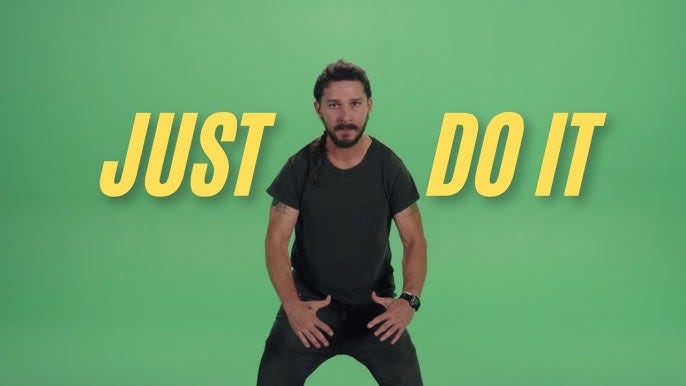
Above: Don’t let your dreams be dreams.
When innocent inadequacies and cute quirks turn into red flags, it almost never happens all at once.
It resembles rust in that it takes place quietly. Gradually. Patiently.
At first, your flaws are endearing. A quirk. A bit. A story your friends tell at dinner. People repeat it while chuckling because no one has paid a price for it yet.
But then one day you hear the same sentence said differently.
You see, as you get older and these willful inadequacies persist, the perception of people around you goes from “That’s just Tom,” with a smirk and a twinkle in the eye to “That’s just Tom,” with a downcast look and a clenched jaw.
The joke no longer hits because you’ve become the punchline.
There’s a moment in adulthood when you realize the room has stopped laughing with you and started working around you.
When “that’s just how I am” stops being a charming signature and starts sounding like a warning label.
The process of growing up is a slow, gradual shoring up of weaknesses until they become strengths—or at least tolerable and good enough—so you can stand on your own two feet in a world that can be equal parts tumultuous and unkind.
That’s what maturity is, in practice: not some glamorous metamorphosis into a higher being, but a steady willingness to shore up your soft spots before life latches onto and exploits them.
Because incompetency—especially when it travels with laziness—has a predictable arc.
It’s cute at first.
Then it’s annoying.
Then it’s intolerable.
Then it turns fatal because it creeps into every single aspect of your life.1
A missed deadline that becomes a reputation.
A reputation that becomes an opportunity you don’t get.
An opportunity you don’t get that becomes resentment.
Resentment that becomes your personality.
In this way, a small mishap becomes a standard operating procedure and a standard operating procedure becomes a life.
People think their weaknesses are contained. Like they’re a junk room in the house that you can keep messy and just shut the door on.
But weakness doesn’t stay in its lane.
It migrates and spreads the way water does through drywall. It finds the seams. It softens the studs. It compromises the whole structure—and one day, the collapse feels sudden even though it wasn’t.
The world is not obligated to interpret your incompetence as innocence. You only get a short grace period during which people will brook your bullshit.
Time changes the meaning of our inadequacies. The same behavior that reads as harmless at 23 reads as negligent at 33 and as a verdict at 43.
Put simply, you really have to take yourself and your precious life seriously because if you don’t, no one will.
Not because everyone is mean. Because everyone is carrying their own load. Because adulthood is, among other things, a limited tolerance for preventable problems.
This is exactly why writers have always been unsympathetic about preparation. They don’t talk about “getting your life together” as a cute self-improvement project. They talk about it as a brave, daring act of spiritual sobriety.
As Brother Lawrence writes in The Practice of the Presence of God:
Death follows us close; Let us be well prepared for it: for we die but once; and a miscarriage there is irretrievable.
We get one life. One body. One mind. One set of relationships. A limited number of mornings. A limited number of chances to become the kind of person others can rely on.
And a frightening number of our “quirks” are really just ways we avoid that responsibility.
A personal example for me is cooking.
For years, I used to brag about my incompetence in the kitchen. I said it like it was a charming eccentricity. Like it proved I was meant for more rarefied work—mental labor, not manual labor, as I quipped. I wore it as a strange, warped badge of honor: I don’t do that.
At the time, it was funny. It played well. People laughed. It had the energy of “look at this overgrown child in an adult body.”
But then I got older and I realized something obvious that somehow had never landed: basic competence isn’t optional. Not if you want to be free.
The longer you stay helpless in one area of life, the more life begins to feel like a sequence of negotiations.
You can’t feed yourself without asking.
You can’t host.
You can’t care for someone.
You can’t weather inconvenience without outsourcing it.
You can’t travel without dependence.
You can’t build a stable home if the home is always one small crisis away from collapse.
And the modern world makes it dangerously easy to remain incompetent:
Order takeout.
Order groceries.
Order AAA to change a tire.
Call someone to fix simple things.
Pay fees and subscriptions to smooth over every rough edge of reality.
In the short term it’s convenience. In the long term it is a quiet atrophy, as we outsource not just tasks, but our very capability.
And capability is a form of dignity not only for ourselves, but also for those we hold most dear.
It’s the difference between living inside your life and merely renting space in it.
Eventually I had a moment where I felt, not guilt exactly, but something more clarifying: I didn’t want to be the guy people had to plan around. I didn’t want my life to depend on the availability of other people’s competence.
So I started learning.
Shout out to Salt, Fat, Acid, Heat—a wonderful cookbook-cum-explanation of cooking science—because it gave me what my modus operandi never had: a system. A way to understand what was happening, rather than just guess. Suddenly the kitchen wasn’t chaos, it was cause and effect. Heat changes texture. Salt wakes things up. Acid brings clarity. Fat carries flavor.
It went from mystical to learnable.
And once something is learnable, your “quirk” loses its innocence.2
Because then “I can’t” becomes “I won’t.”
And when you utter “I won’t,” that’s the precise moment when quirks turn into red flags.
A red flag is just a weakness that has started charging interest.
A red flag is what happens when the story you tell about yourself stops matching the consequences you generate.
A red flag is the moment the people closest to you realize they can’t keep laughing because the punchline keeps costing them.
I don’t think the goal is perfection. That’s just vanity.
The goal is seriousness. A willingness to shore up the parts of you that keep collapsing in predictable ways. To stop confusing acceptance with indulgence. To stop calling avoidable incompetence “personality.”
Naval Ravikant wrote:
You cannot hide anything from yourself. Your own failures are written within your psyche, and they are obvious to you. If you have too many of these moral shortcomings, you will not respect yourself. The worst outcome in this world is not having self-esteem. If you don’t love yourself, who will?
What are you still calling “just you” that everyone else has started quietly calling “a problem”?
Maybe it’s not cooking.
Maybe it’s money.
Maybe it’s punctuality.
Maybe it’s the way you avoid hard conversations.
Maybe it’s the way you always run a little behind, a little scattered, a little “hehe, sorry don’t mind me.”
Maybe it’s your health.
Maybe it’s your temper.
Maybe it’s your inability to finish what you start.
Whatever it is, it probably still feels cute to you because you’re the one who benefits from the story and doesn’t suffer its side effects.
But listen for the shift in the room.
Listen for the sentence said without the smile.
“That’s just Tom.”
And then the silence after it, where everyone quietly agrees: Yes.
That is just Tom.
And that’s the problem.
Per my about page, White Noise is a work of experimentation. I view it as a sort of thinking aloud, a stress testing of my nascent ideas. Through it, I hope to sharpen my opinions against the whetstone of other people’s feedback, commentary, and input.
If you want to discuss any of the ideas or musings mentioned above or have any books, papers, or links that you think would be interesting to share in a future edition of White Noise, please reach out to me by replying to this email or following me on X.
With sincere gratitude,
Tom
Fatal doesn’t always mean dramatic or morbid. Sometimes it just means irreversible.
And now, with YouTube, AI, et al, there are no excuses anymore, just sloth.
Excellent as always.
Most people will treat you to the extent you treat yourself by default and vice versa. It’s important to treat yourself well so that you are treated well and so you treat others well.